How a kitchen takes life: the phases of realization

How a kitchen takes life: the phases of realization

Discovering bespoke furniture, have you ever wondered what are the phases of realization that give life to a kitchen? We are ready to show you our creation and production process! The design of a custom-made kitchen is born from the meeting between the customer’s wishes and personality and the designer’s experience, capable of satisfying the functional and aesthetic needs of both. What the customer sees is the transformation of the project, shown in its most satisfying graphic form, into a finished and complete product. However, there is a world behind the creation of a kitchen: from the artisan production phase, with boards with strong resistance and workability, to the painting of the components, from transport with packaging to final assembly. Let’s follow the production process of this minimal kitchen.
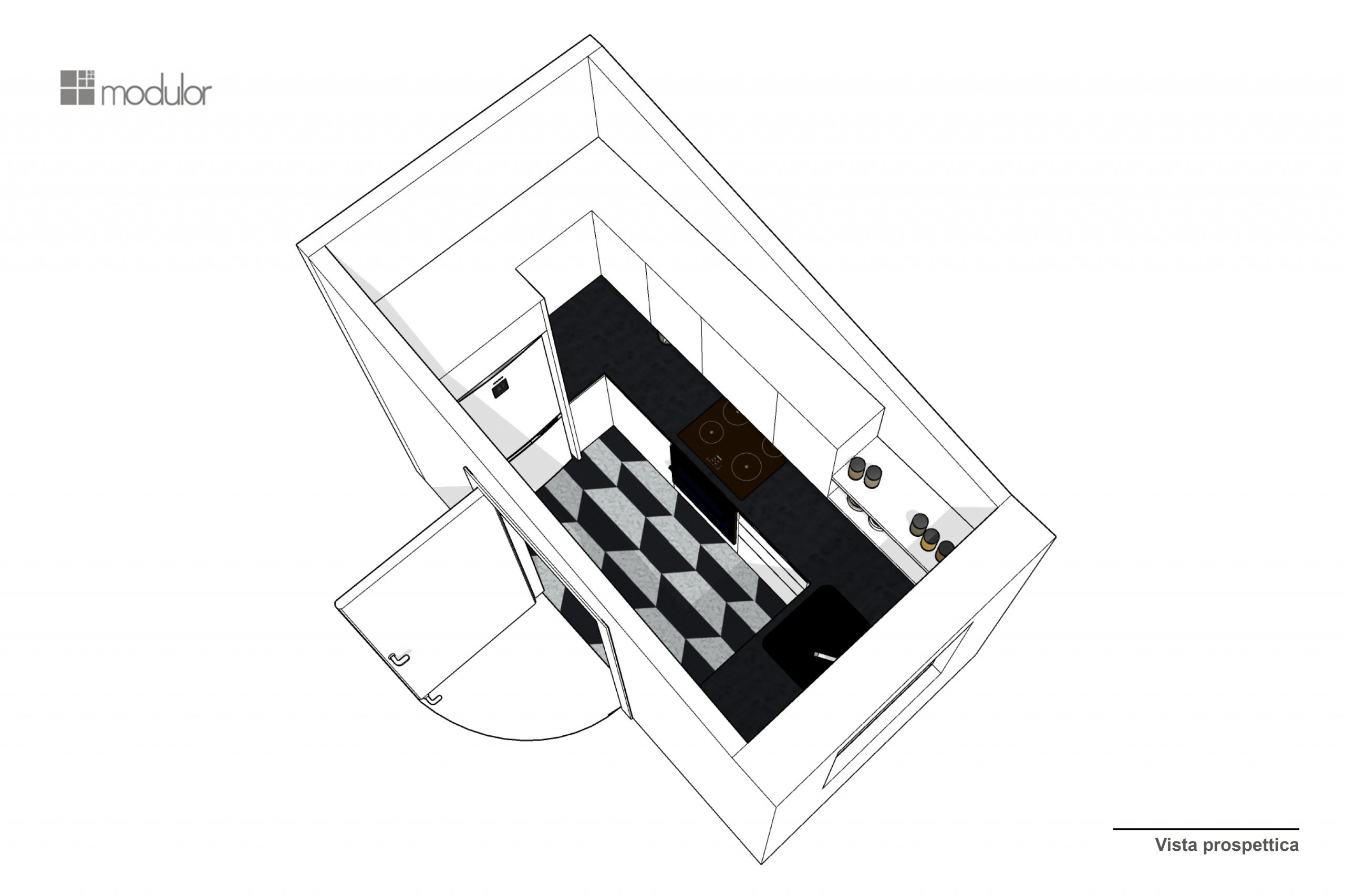
design phase perspective phase

The design: a continuous dialogue with the customer

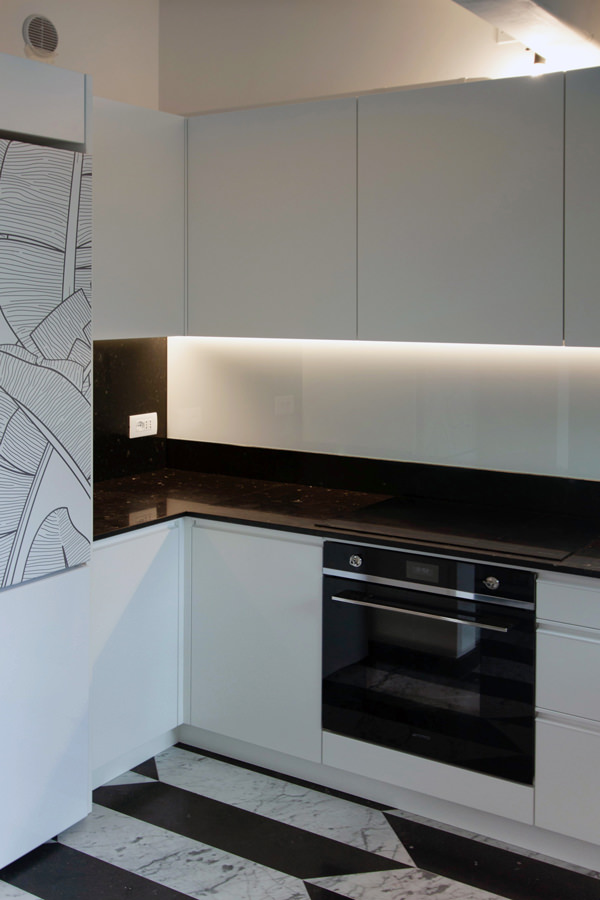
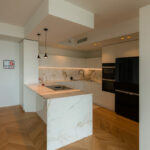
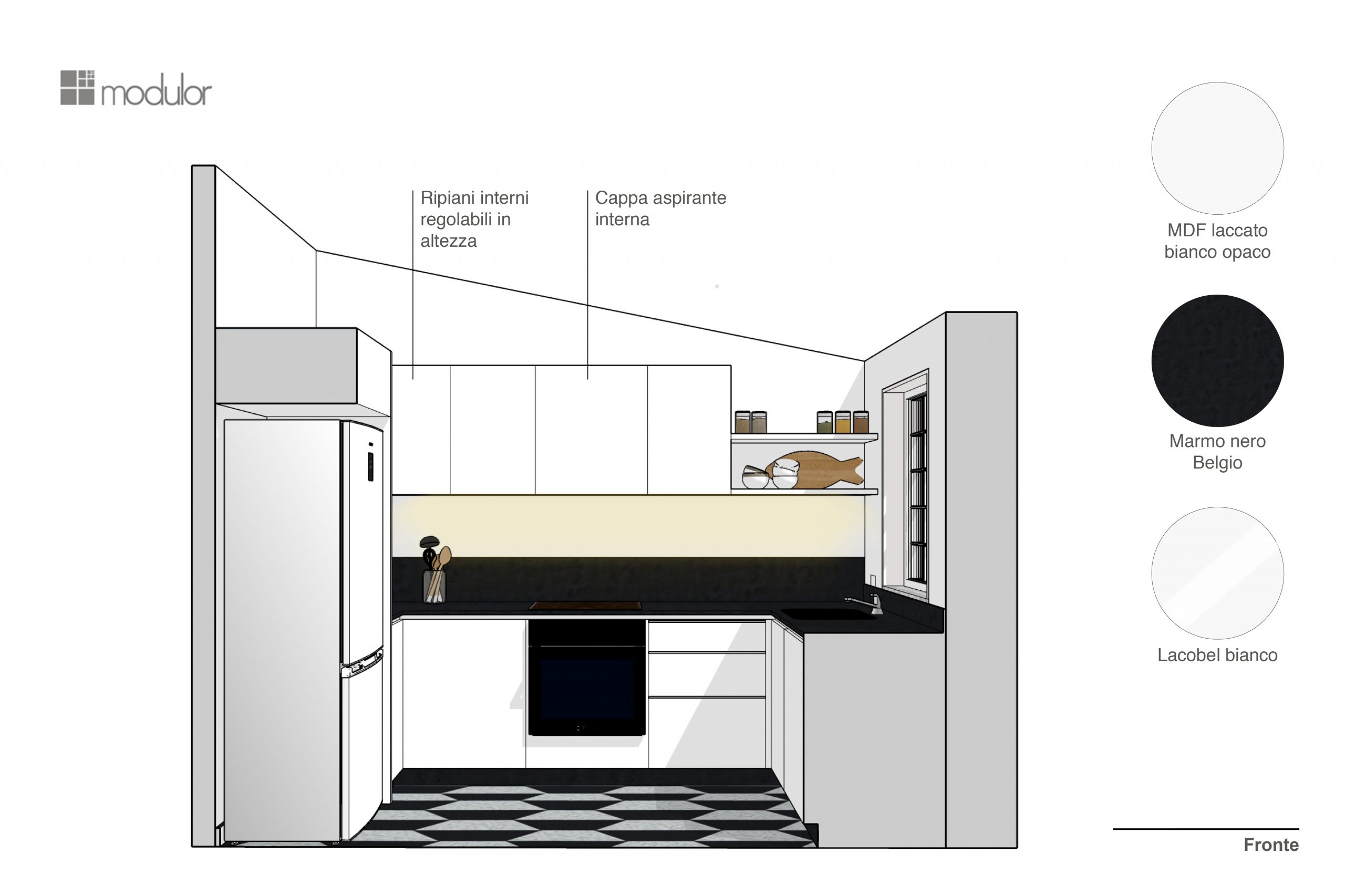
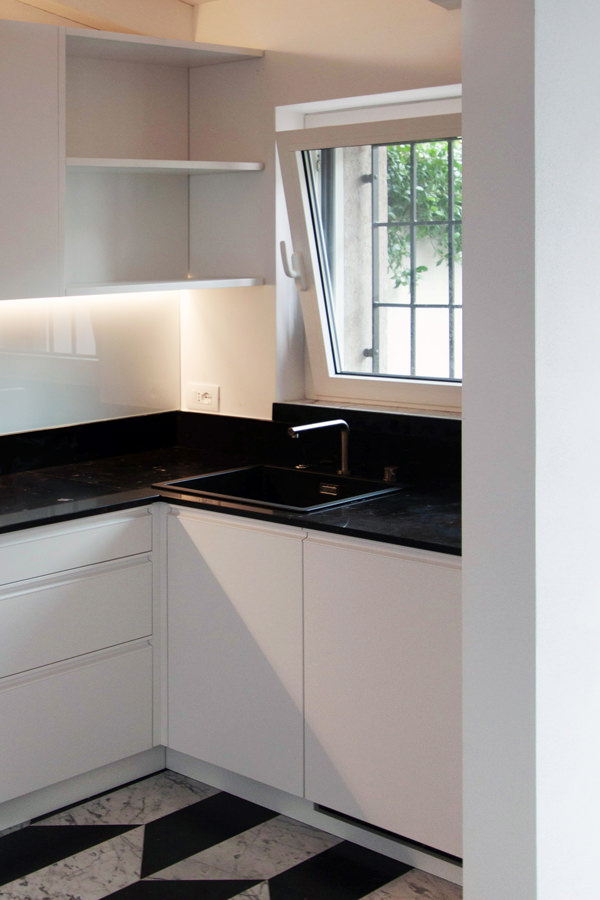
The design of this kitchen stems from the need to optimize spaces in an environment already strongly characterized by floors with geometric marble patterns. The presence of a relevant flooring has given rise to a project that responds to the same chromatic characteristics. In this way, the minimal line of this kitchen is born. Here, the lower volumes and upper wall units in matt white lacquered MDF give brightness and freshness. The black marble top houses the built-in sink and the induction hob, transforming into a splash back and side back. The vertical reading wall units holds the hidden lighting that is also reflected by the white Lacobel splash back. The graphic rendering of the project allows you to get an idea of ​​the general layout of the kitchen, studying the different components based on the best practicality. We try color and material combinations and studies alternatives in the volumetric composition. In this phase, the ability to read and interpret the client’s wishes is essential for the designer. On the other hand, the customer plays an active role, becoming an integral part of the design team. The best projects are in fact those that do not stop at the first solution, but undertake new design challenges, evolving from time to time following the brainstorming between the client and the designer.
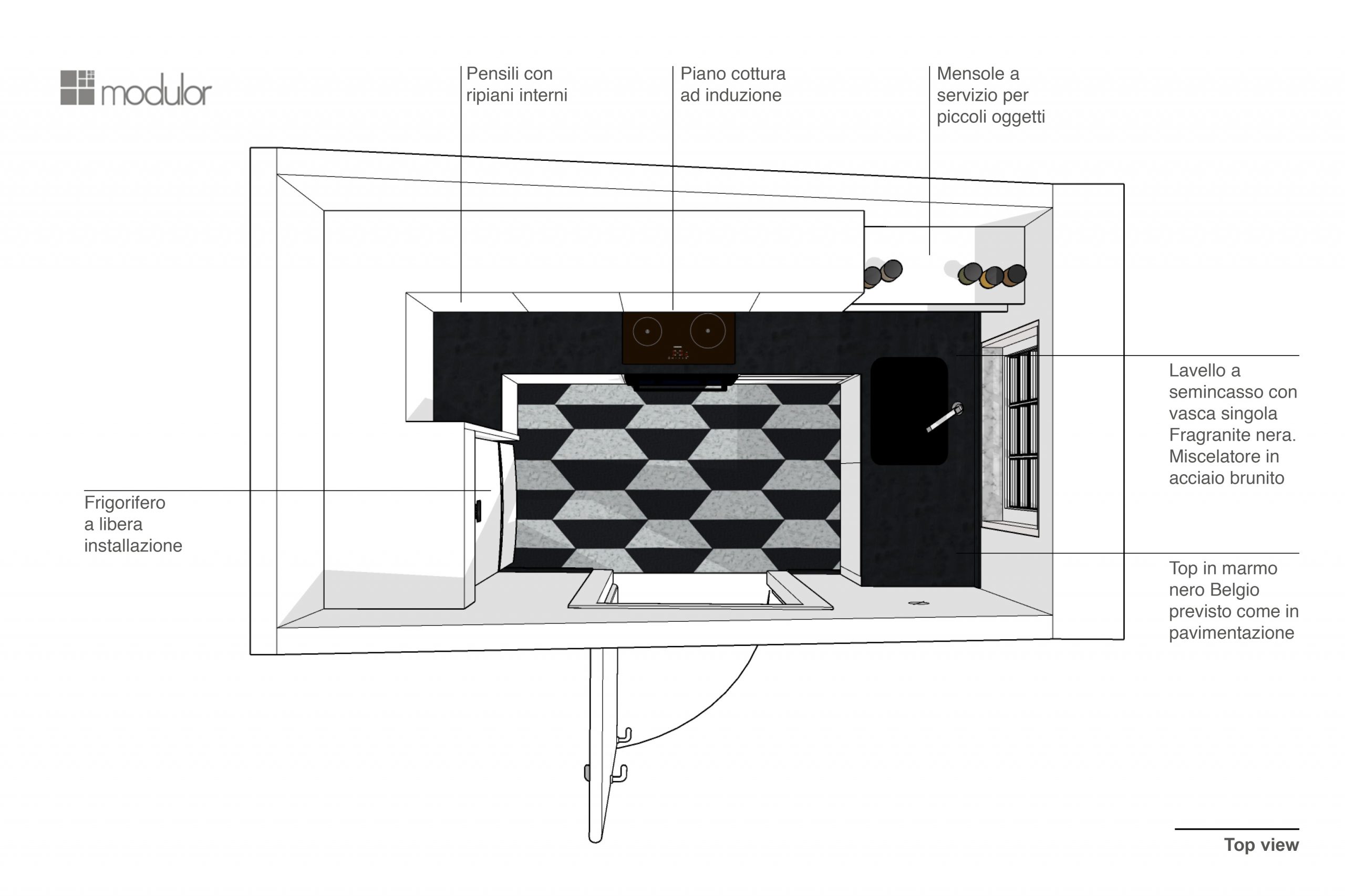
design phase top view
Minimal kitchen Verona design  front

From the design offices to the lab: the executives

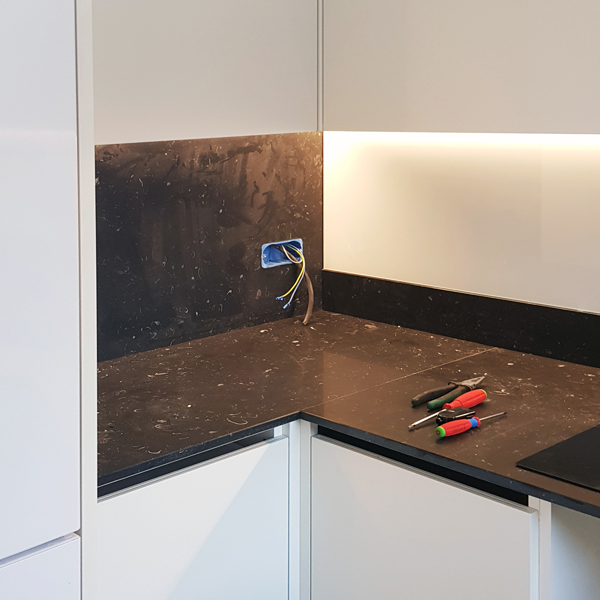
Once approved and defined in the smallest detail, the kitchen project goes directly to our laboratory, ready for the construction phase. The three-dimensional model developed during the design phase is reworked to take on a new look. From a graphic and realistic setting, it is transformed into a functional model from which the executive tables are processed to be addressed to our artisans. After an accurate on-site survey, where electrical predispositions, discharge and existing constraints are highlighted, the model is adapted and designed in detail. Extremely simple designs that give up their aesthetic presentation in favor of greater clarity of reading. Dimensions, cuts and joints are underlined to make the realization cleaner. Our kitchen is therefore broken down, from a three-dimensional model in digital format to A3 tables with plants and elevations so that the experience of our craftsmen can give life to the actual realization.

Between cuts and painting: the realization in laboratory

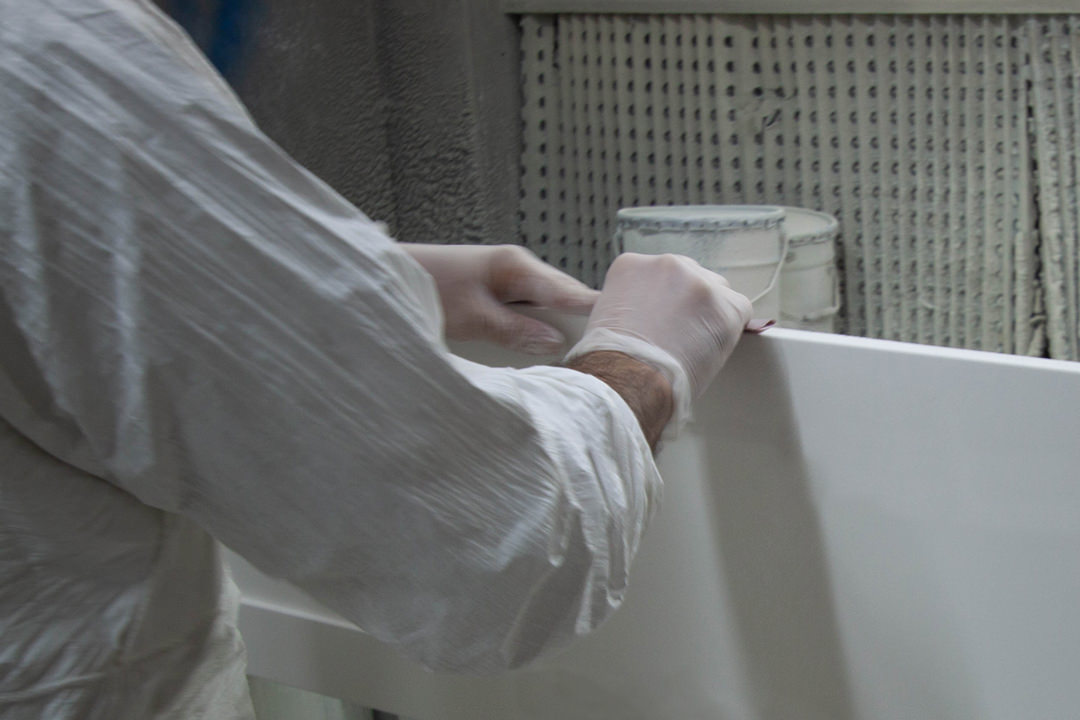
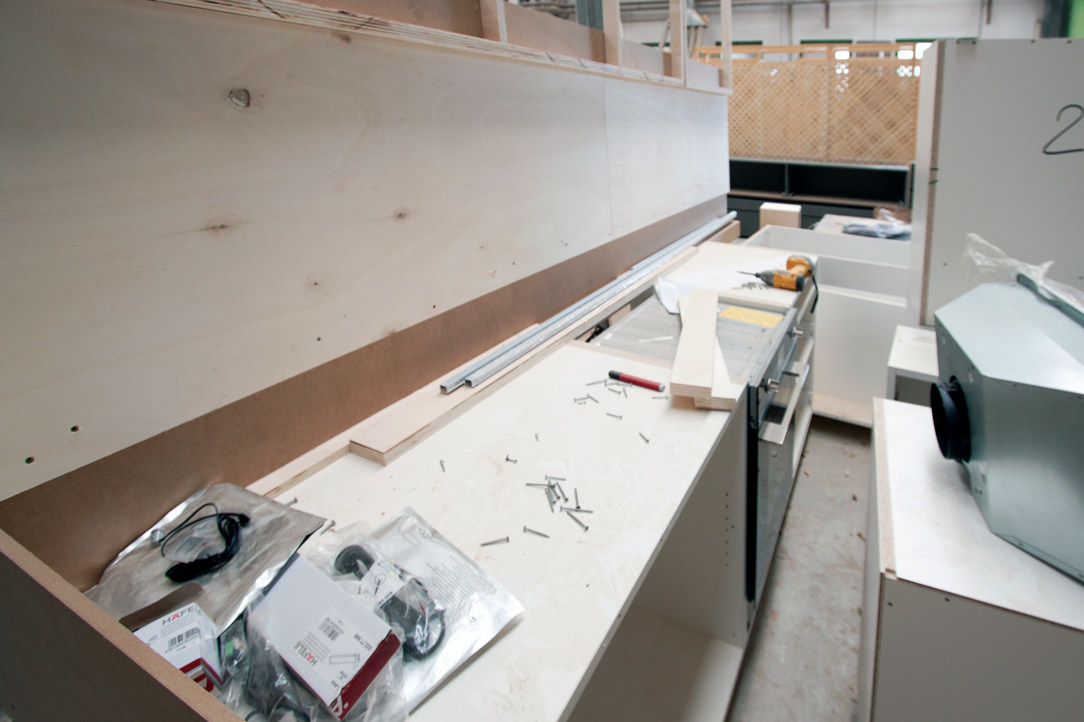
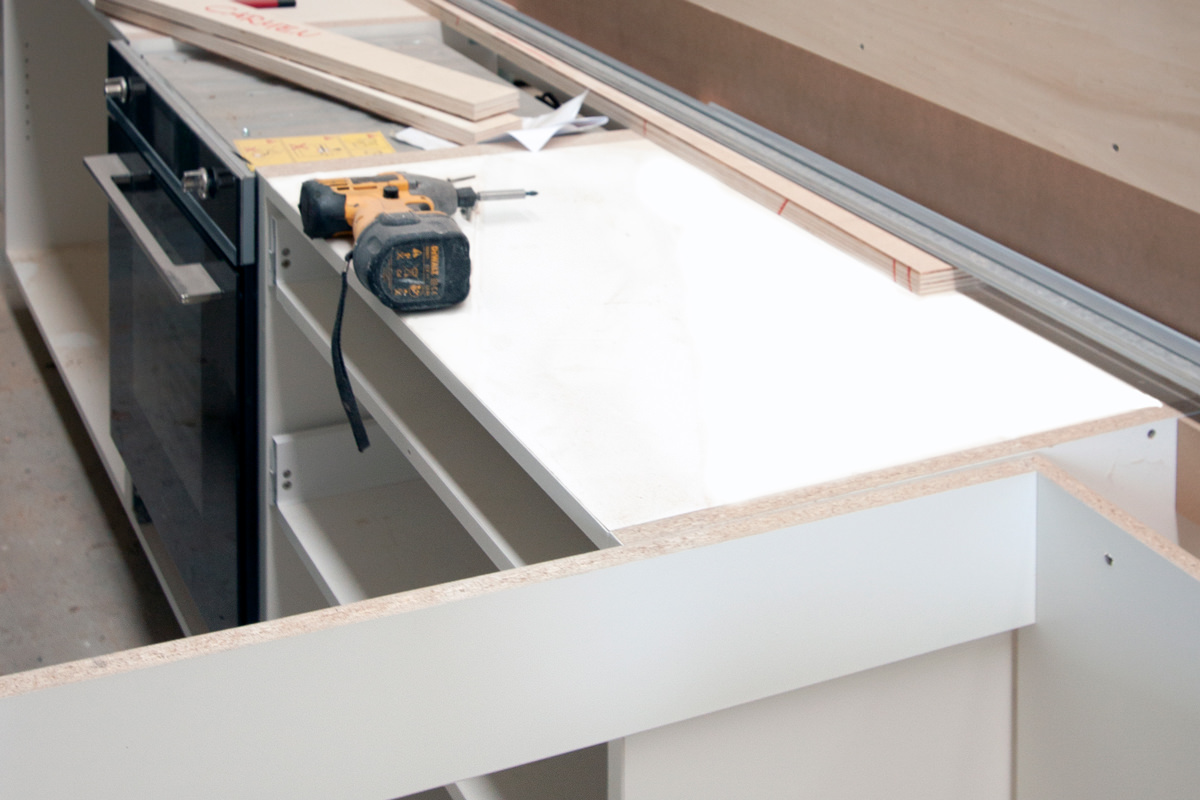
The MDF boards are cut with special machinery preparing the joints for household appliances and related attachment points. Any special processes are carried out with the numerical control machine or with the pantograph, at rest during this project. In the meantime, our guys in the internal painting department prepare the samples with the different chromatic shades. There are infinite shades of each color,. Even of white, that contextualized in an interior can give life to different effects and perceptions. Once the cutting of the single components is finished, the assembly test takes place. Screws, hinges and drawer guides now come into play by verifying the right composition of the kitchen, which is in full construction phase. If our bespoke furniture passes the assembly test, the components are broken down again and passed to the painting compartment.
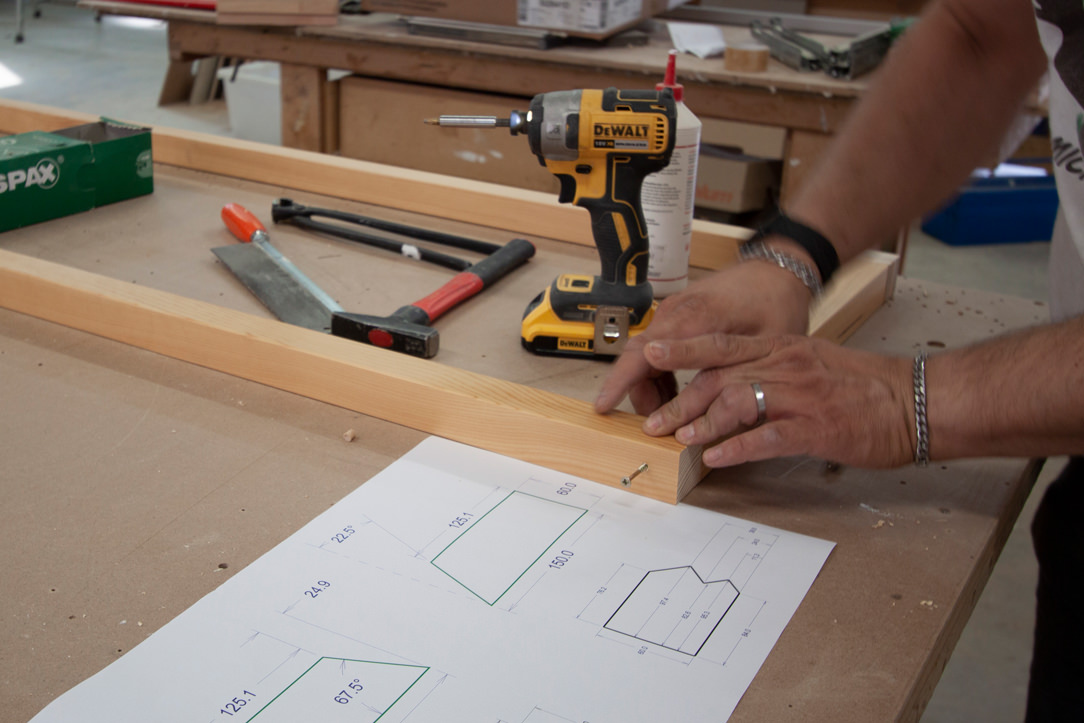
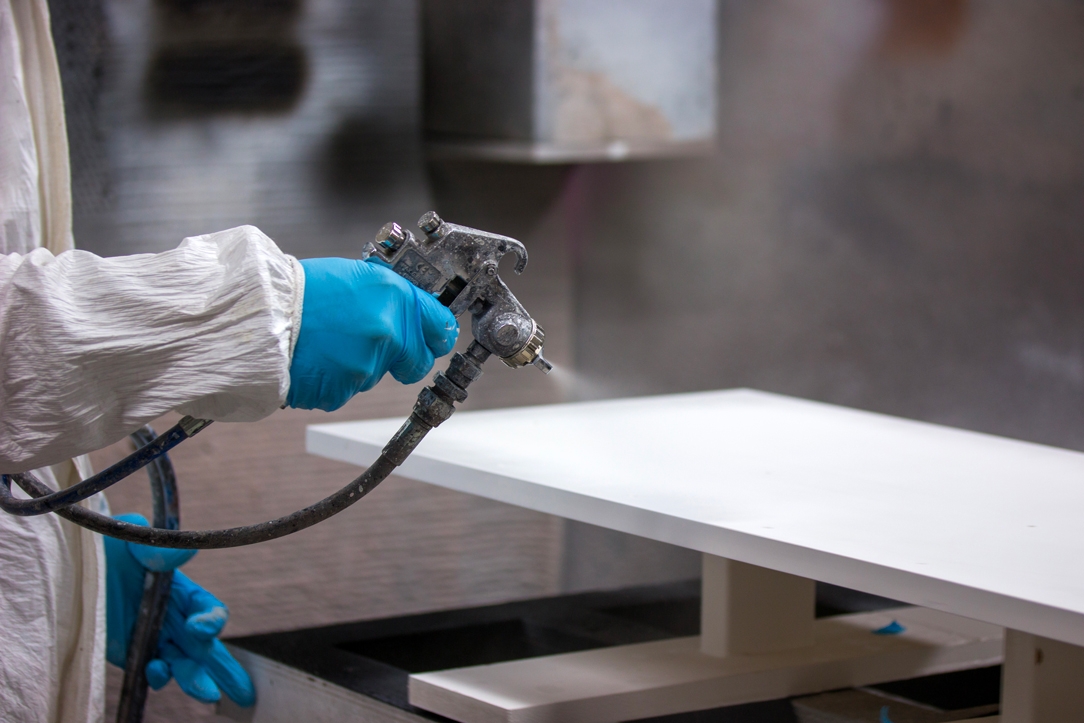
minimal kitchen realization
painting laboratory
laboratorio piallatura
assembly test Minimal kitchen Verona
Assembly test laboratory

Traveling to the final destination

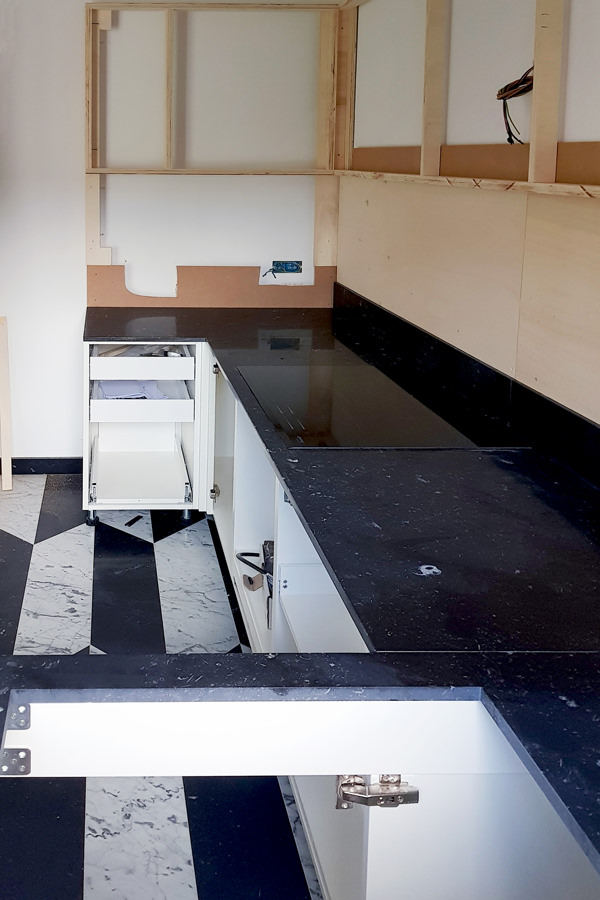
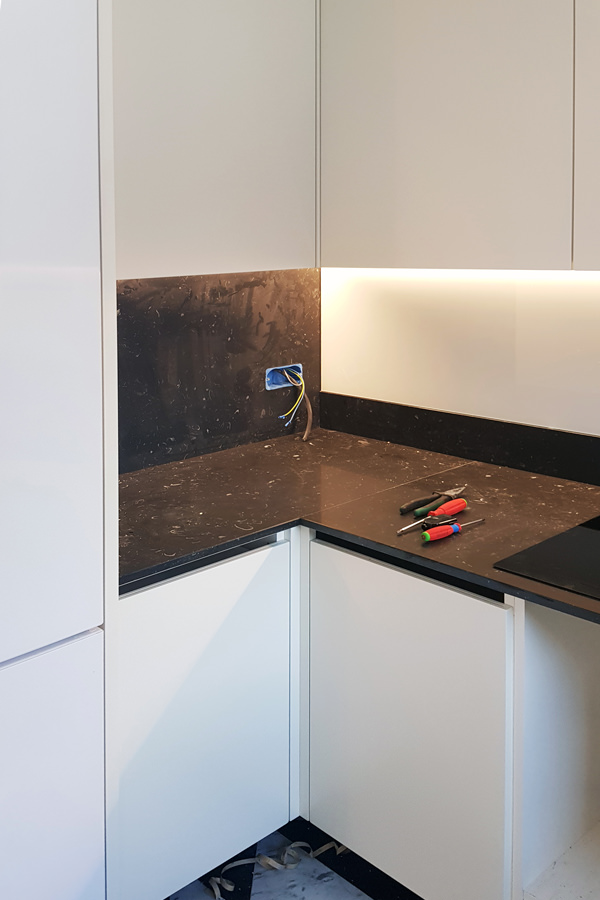
The different components are ready to undertake on their journey. The packaging is careful and punctual, ready to foresee and avoid damage during transport. The load is organized in order to optimize the movements, whether it is short distances or in the case of international travel. Packed properly and accompanied by all the appliances required, our kitchen leaves for Verona, ready for the big day of presentation to the customer. Expert hands and assembly tool kits quickly shape our minimal kitchen. The load-bearing structures for wall units and lower volumes are prepared, to which the various external components are gradually added. Lighting under the wall unit, handles with aluminum shell, shelves with rods for height adjustment. All details that now become fundamental for the final realization of the kitchen. Once the assembly is complete, broom hands, dustpan, vacuum cleaner and good hand works. Everything is cleaned from dust and work shavings, removing any protections and any construction site structures. And here it is, bright and minimal, functional and able to accommodate products and foods of all kinds.
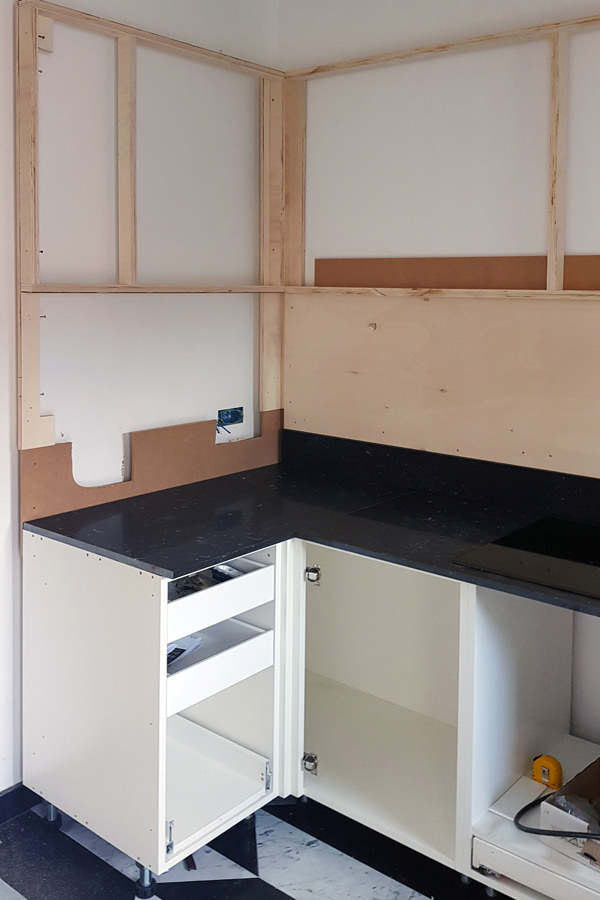
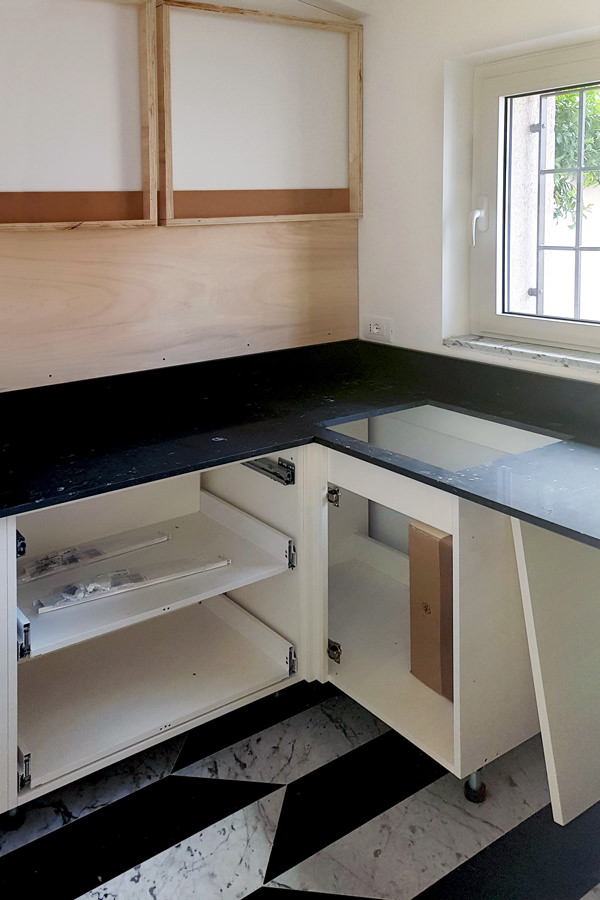
assembly phase Minimal kitchen Verona 01
assembly phase Minimal kitchen Verona 02
assembly phase Minimal kitchen Verona 03
assembly phase Minimal kitchen Verona 04

A minimal kitchen: the final product

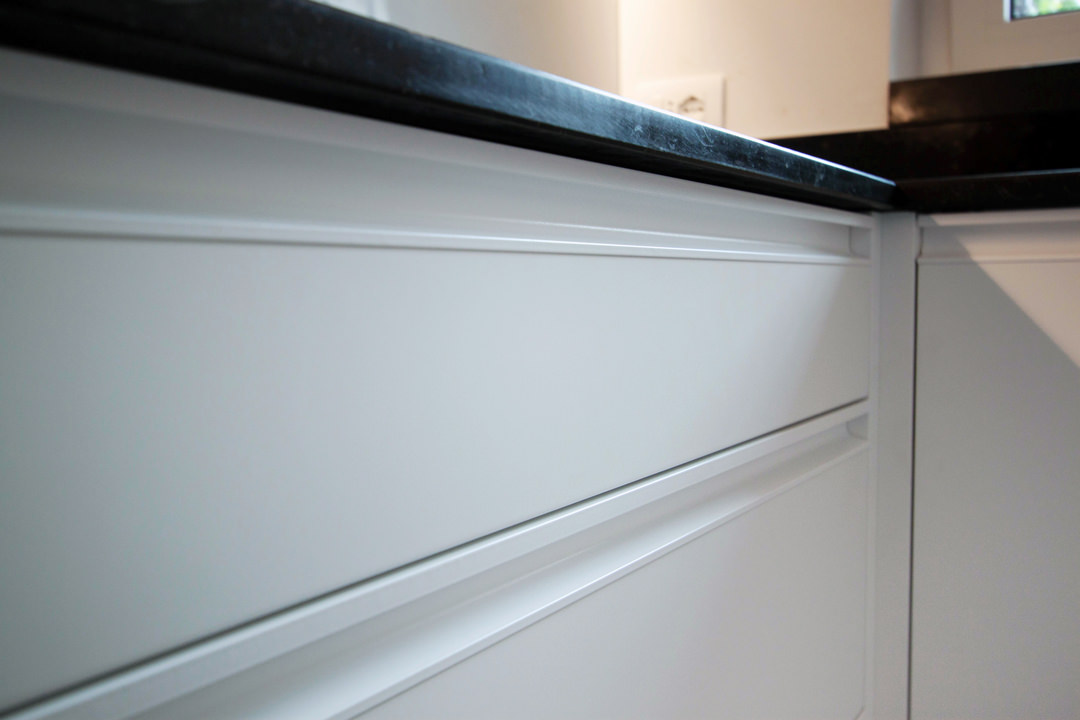
The day of the official presentations has finally arrived. The black marble top chromatically contrasts the lower volumes and white lacquered wall units. Different storage points ensure space optimization with removable trays and baskets but also height-adjustable internal shelves. The drawers for cutlery, table linen and pots are designed in different heights depending on their use. The recessed handle makes the aesthetic impact elegant and essential, while the white painted shell ensures greater durability and resistance over time. Upper shelves are perfect for small objects, visually lightening the terminal part of the wall units. In this way the natural light diffused by the side window spreads freely in the space giving a touch of freshness. After viewing the finished product with the customer, with a good handshake and the wish for a next collaboration, we come back to the base, ready for new challenges! Other projects are already under construction and willing to become reality. To continue your journey discovering the creation of a kitchen, you can learn more about the types of cladding: an Emperador marble kitchen and a kitchen entirely steel covered.
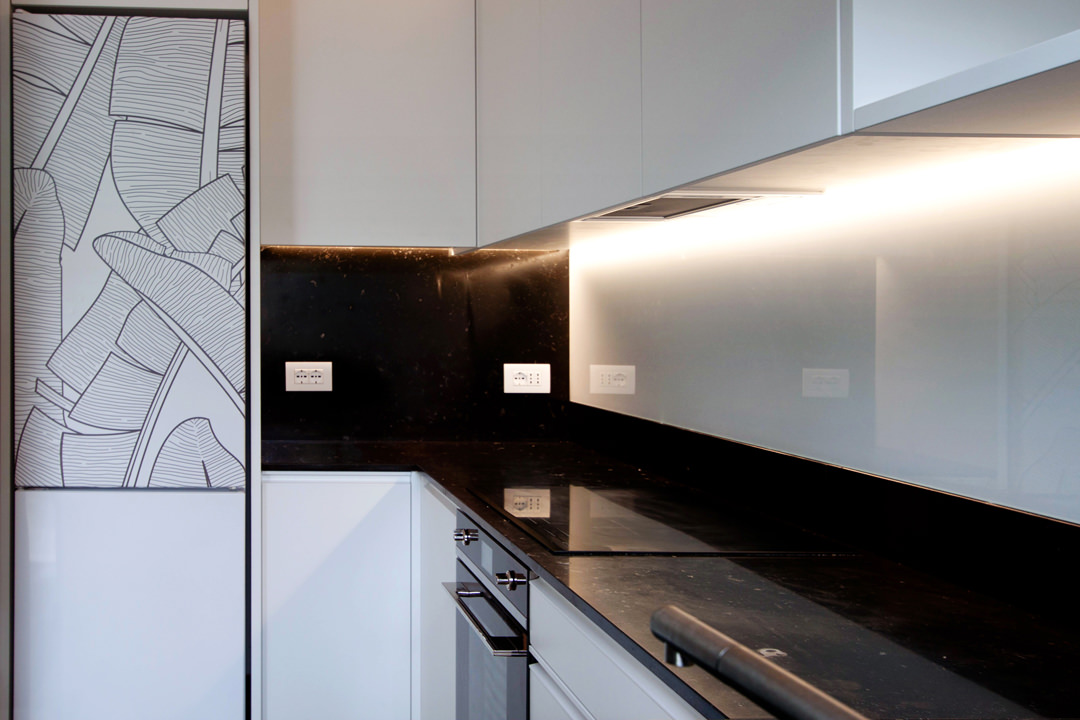
finished product minimal kitchen
windows view kitchen
refrigerator view minimal kitchen
recessed handle drawers detail

A cerulean blue modern kitchen

A cerulean blue modern kitchen

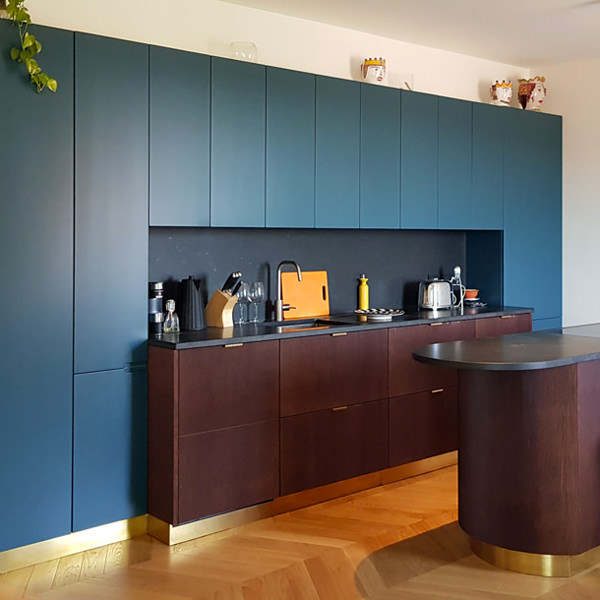
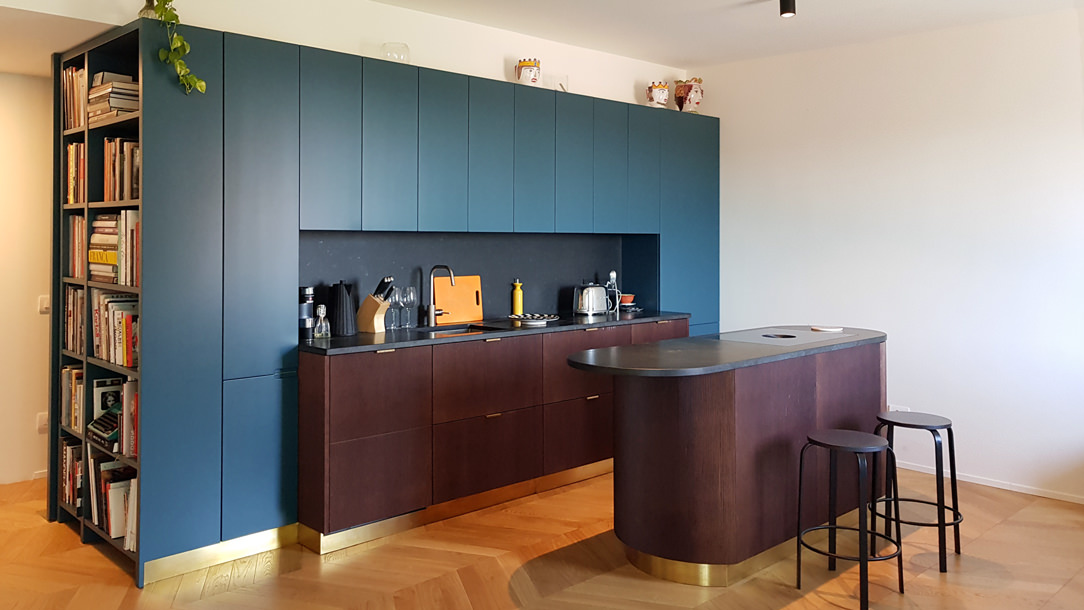
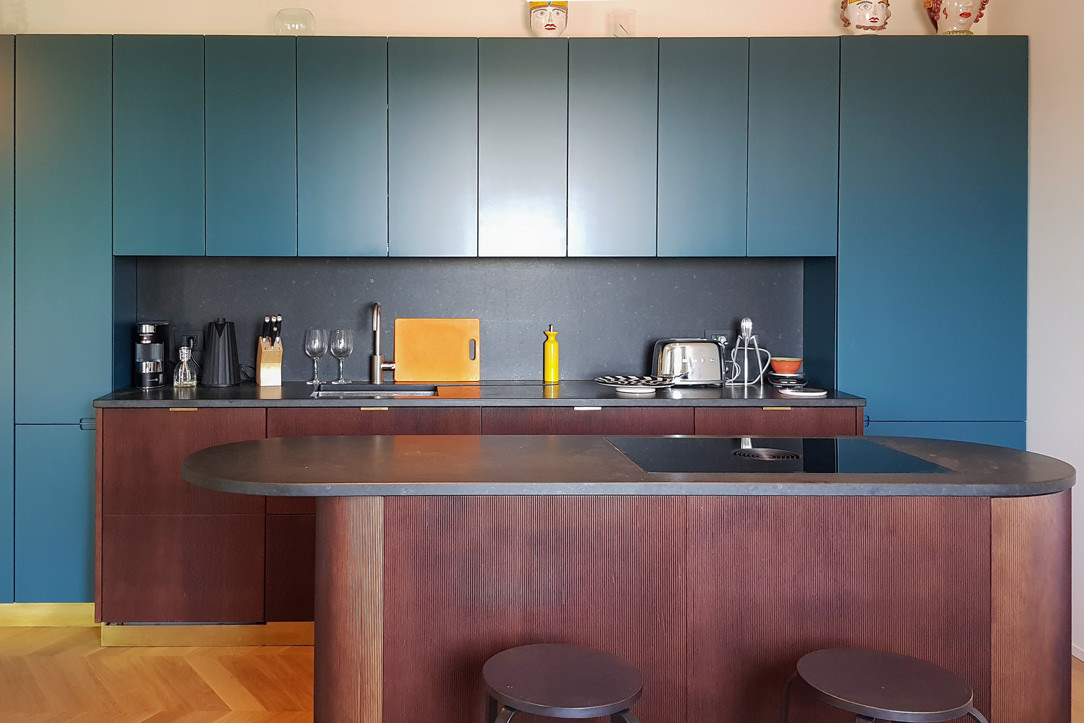
The cerulean blue hue defines the stylistic firm of this modern kitchen, set on dark wood tones with brass finishes. The care of detail gives shape to an extremely elegant project, modern in aesthetics and contemporary in settings.

Modulor modern kitchen with dark tones_01

The on-view composition

An interior that becomes furniture. The design of this kitchen diverges from the traditional vision of the closed room to become an open space composed of different volumes.
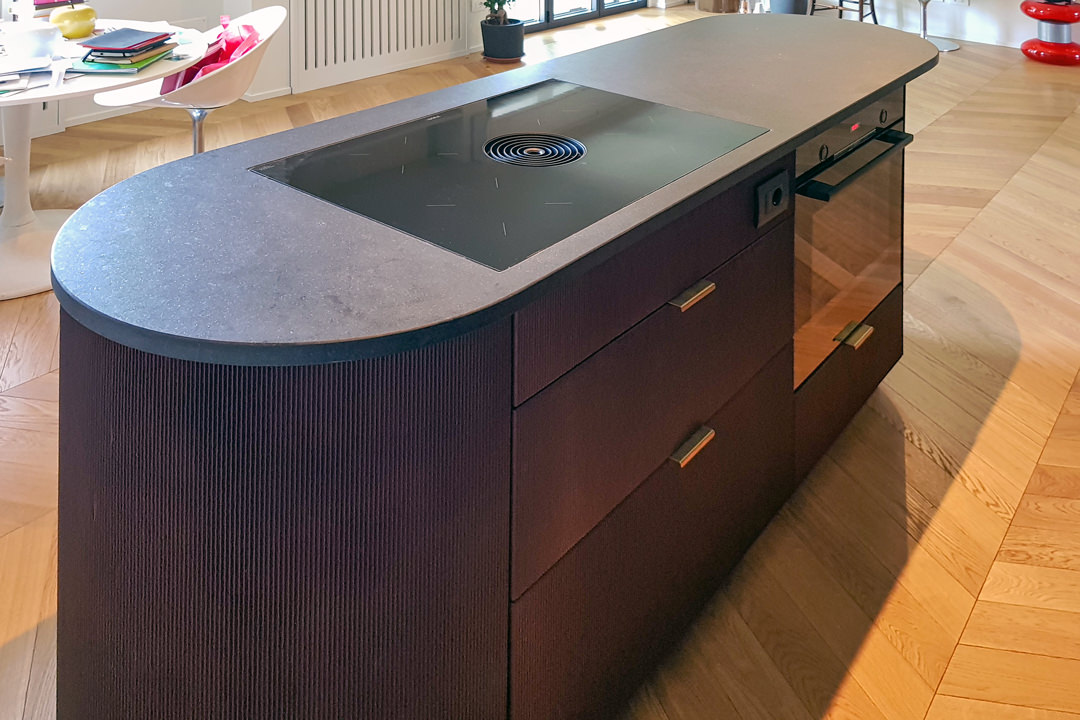
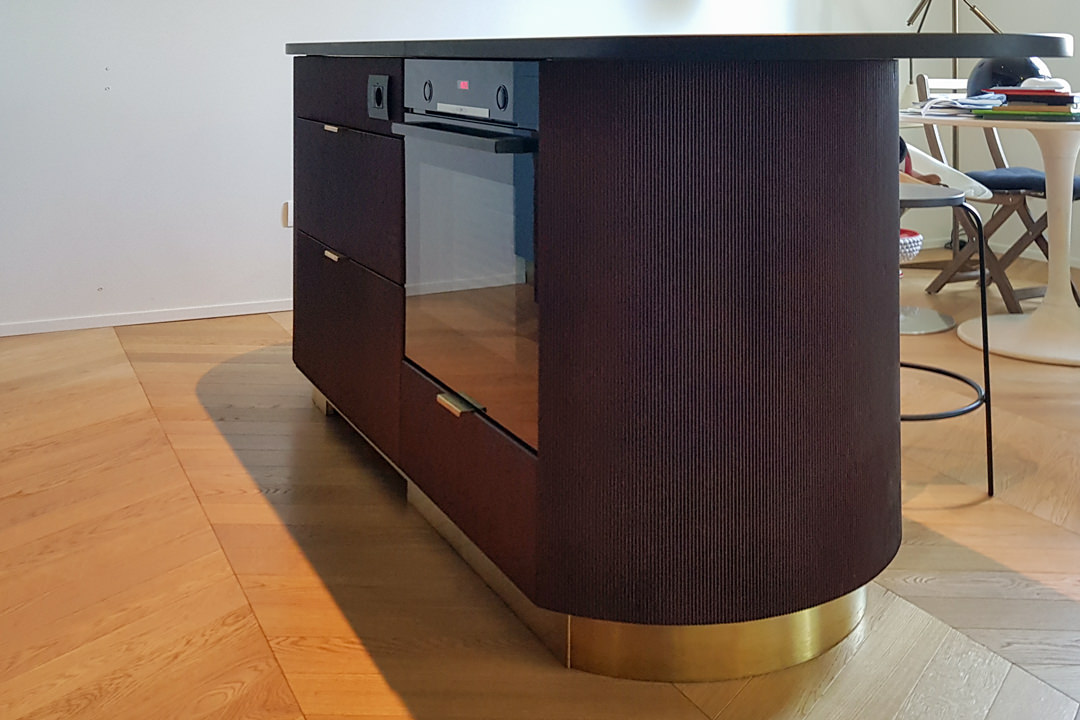
The main block is a visual union of the low volume in ribbed wood set between wall units with a vertical subdivision and full-height columns.

The common thread that contain the perception of the environment is the brass base, taken from the light and linear handles.
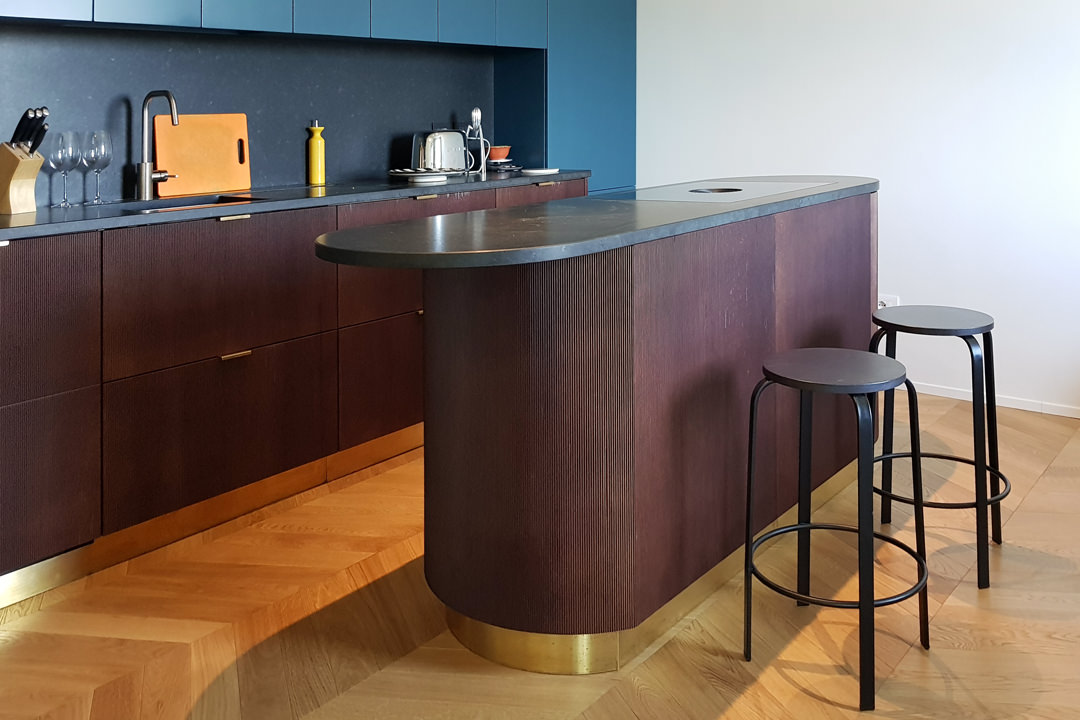
The island block with rounded shapes and overhang countertop, elegantly conforms to the main volume, despite a stylistic change in the design forms.

Indeed, it is this difference between the straight and geometric shapes of the back unit and the rounding of the profile in the central island that defines the stylistic imprint of this kitchen.

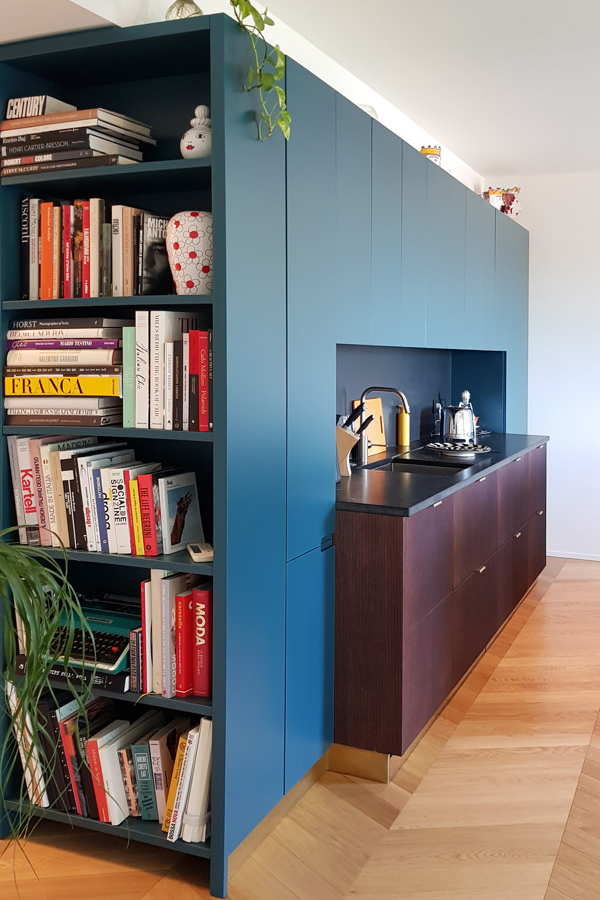
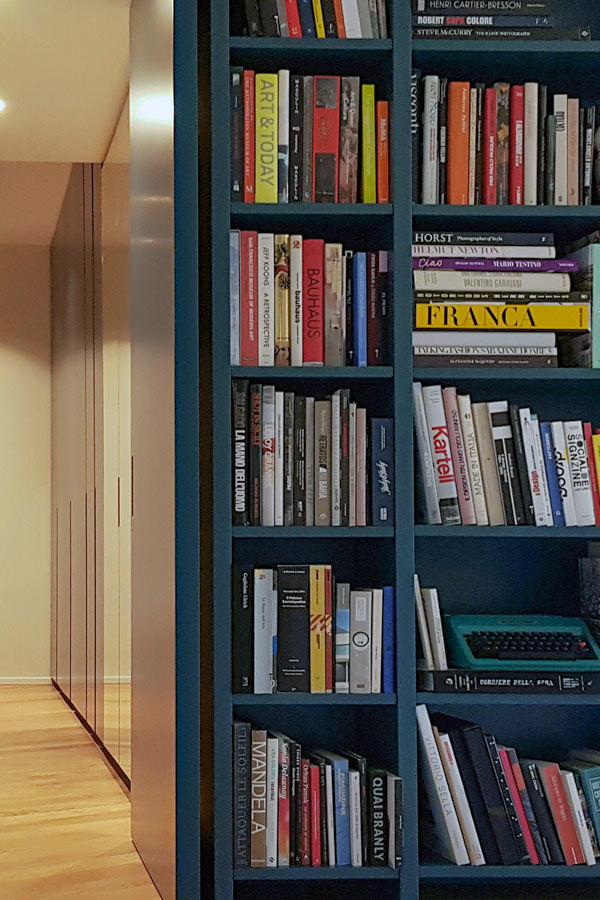
The traditional closing shoulder is replaced by a recessed library that visually lightens the perception of the kitchen characterizing the furniture. A full-height bookcase compartment that alternates shelves in a well-balanced geometric composition.

recessed bookcase side abutment
bookcase abutment division sleeping area
Modulor modern kitchen with dark tones_02

Functionality and aesthetics in symbiosis

Not only the general volumetric setting, but also the internal organization demonstrates a perfect relationship between functionality and aesthetics.

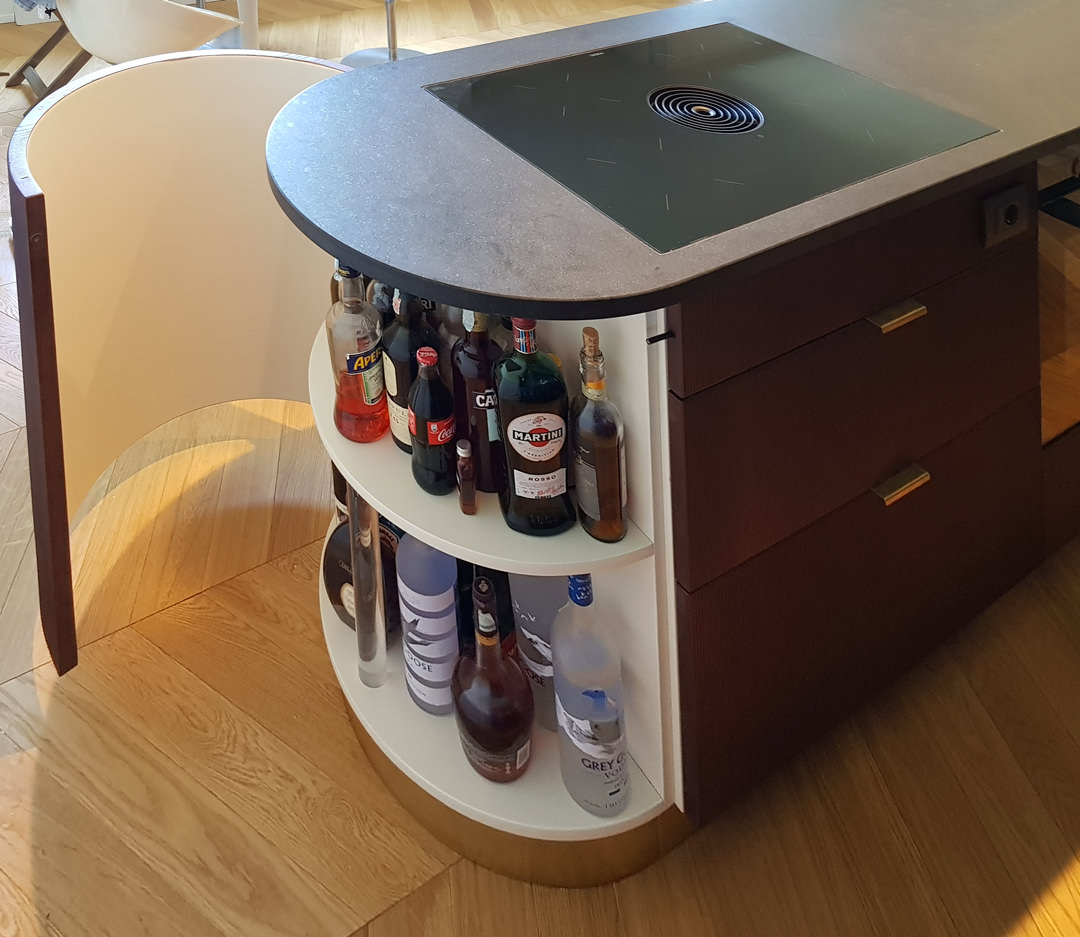
As a demonstration of this, the central island is equipped with rounded corner doors in order to make the best use of each available corners.
Shaped white shelves stand out among the dark tones and blue doors of this modern kitchen, showing all their functionality. The choice of appliances is also avant-garde, as for example the induction hob with attached extractor hood that reduces the functional components to the essential in favor of visual essentiality without sacrificing the practicality.

Modular kitchen island ribbed wood
open door with shaped shelves

Colors and materials

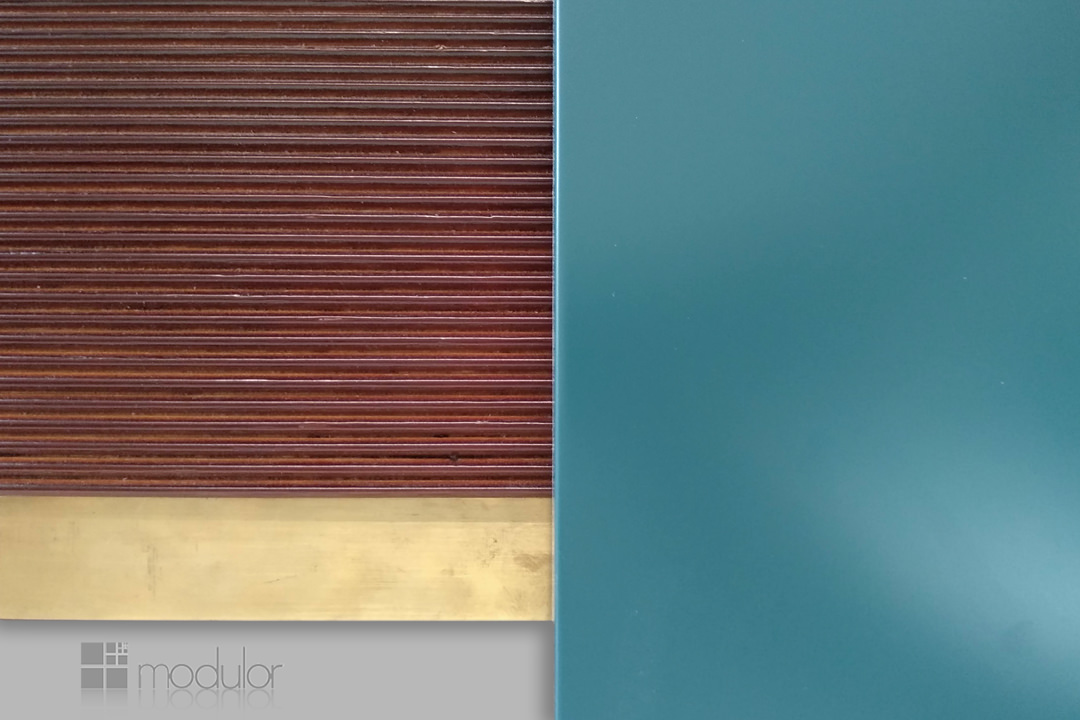
Cerulean blue matt lacquered MDF, dark ribbed wood and brass are the protagonists of this modern kitchen in which dark tones are chosen for their elegance.

A rigorous environment that is being fascinated by contemporary functionality.

The chosen shade of blue, extremely modern, is enriched with a warm appearance especially when combined with the dark-dyed ribbed.

It is precisely the materiality in the latter’s finish that enriches the main volumes of the kitchen with movement and rhythm.

The brass of skirting boards and handles, underlines the design lines with a precious character that gives refinement to the project.

Modulor materialboard
Modulor modern kitchen with dark tones front view
Modulor materials finishes

Advice

The choice of colors and materials often defines the character of an interior. We are often intimidated by intense colors and dark tones, especially if imagined on large surfaces. The final impact can instead reserve great surprises, and give a touch of freshness and modernity.
Here is another example, in this case a dark gray kitchen with oak inserts.

How to equip a bathroom with laundry corner

How to equip a bathroom with laundry corner

A functional and aesthetic analysis of the laundry corner. An environment that in contemporary reality is forced to give up its autonomous room to blend in a small bathroom or equipped corridor. The aim is giving space to the services that define our daily life, making them aesthetically interesting.

laundry corner

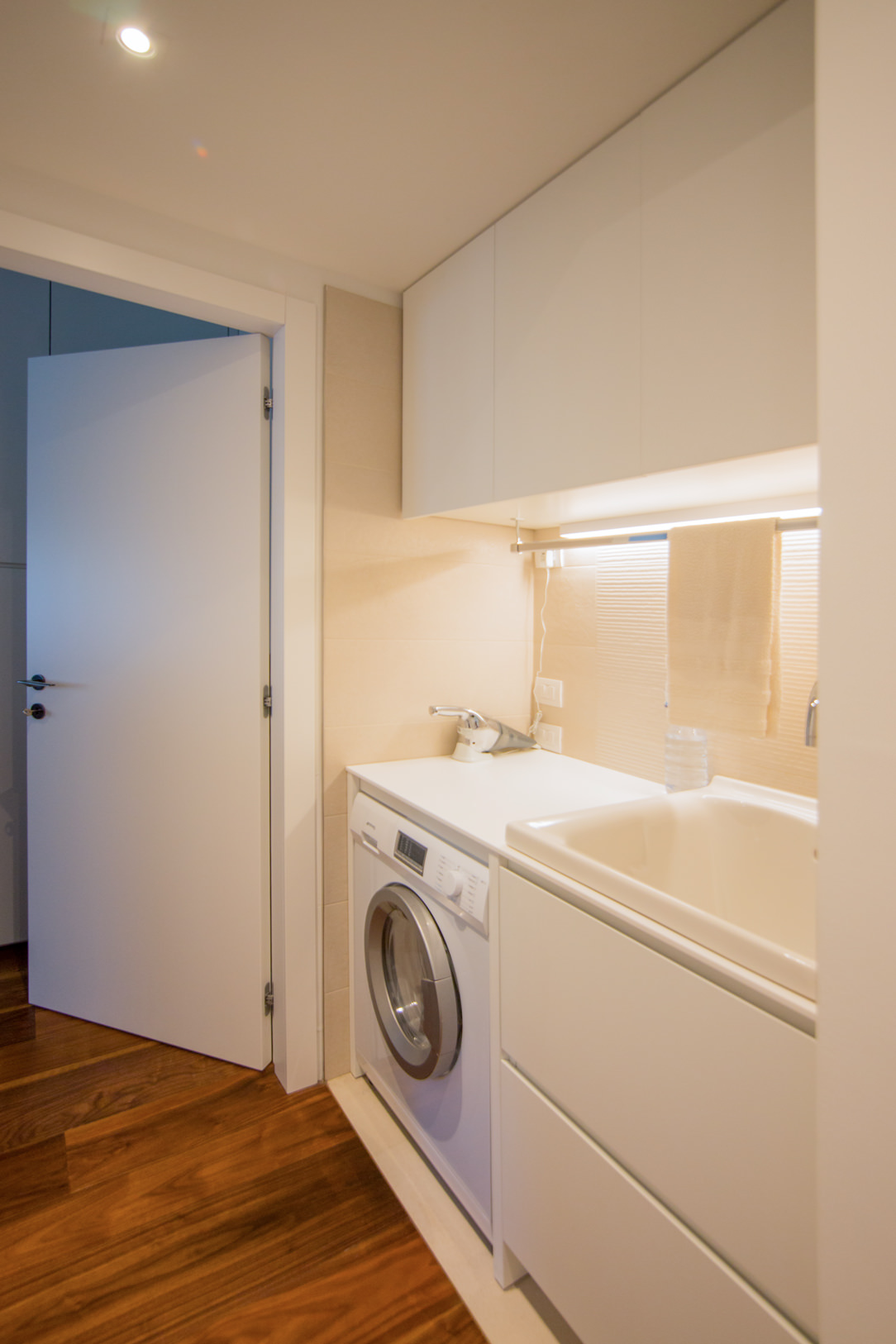
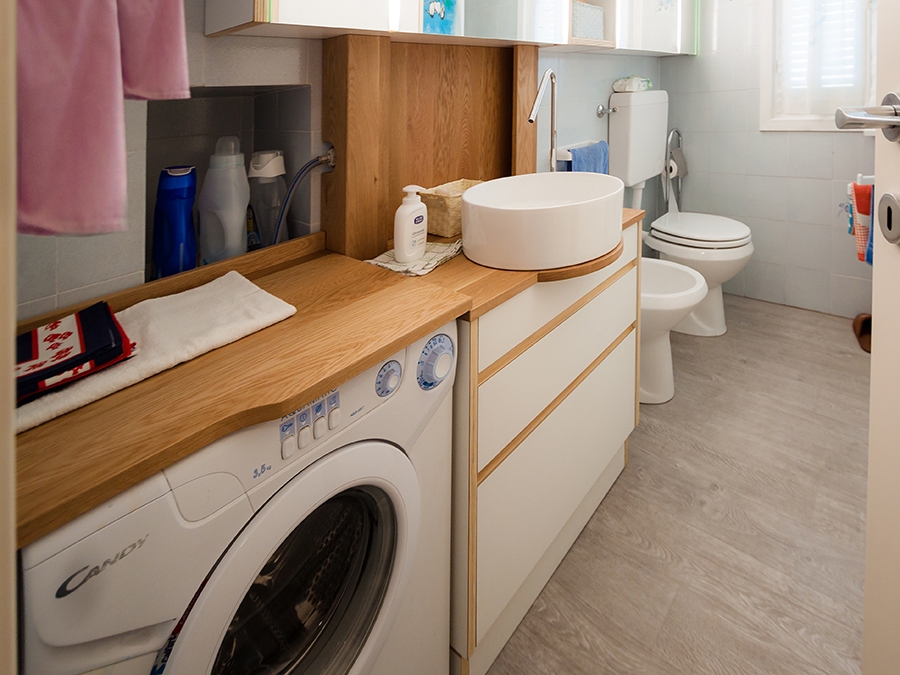
Laundry corner with showed washing machine, basin and compartments furniture

equipped corridor

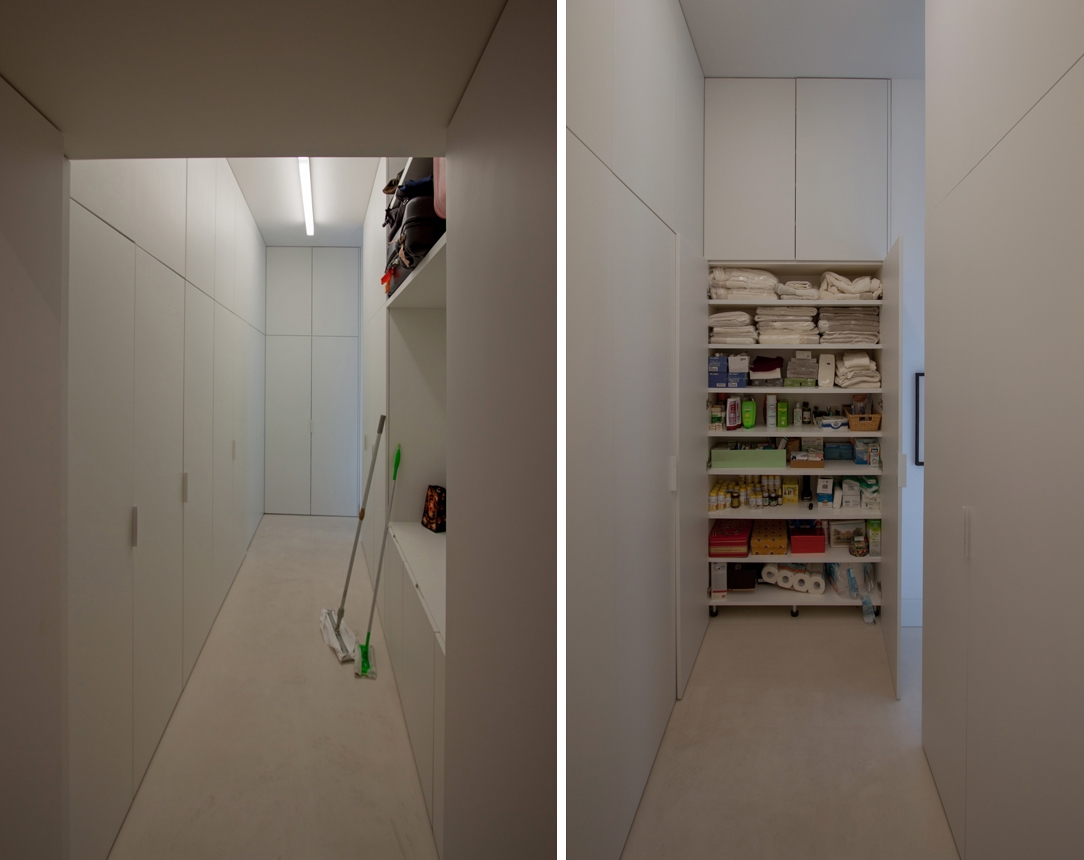
Optimize spaces equipping corridors with serviced wardrobes View the project

Space to services

Speaking of interior design, we are used to imagine elegant living rooms and modern kitchens, contemporary bedrooms and essential-style dining rooms. Over the past few years , the interior design has increasingly taken on the aesthetic meaning of architecture. Let’s remember, however, that design was born as the perfect combination between aesthetics and functionality. The morphology of furniture is nothing else than the natural result of perfect efficiency. It is exactly with this spirit that we want to highlight those “corners of the house” that we usually tend to hide because they are not “beautiful” even though they are basics in the functionality of our domestic spaces. The project layout of each house gets us used to dividing rooms between “living area” and “bedrooms”. The first includes all those rooms that are used to welcoming guests, designed with the aim of return the best public images of the owners. In the “sleeping area”, the most intimate and personal rooms of the owners come to life. However, in this typological distinction are missing all the rooms which, whether private or public, carry out a real function. Among these, just think of the laundry room, which over the years has changed its conformation adapting to the needs of the time.

washing machine recess

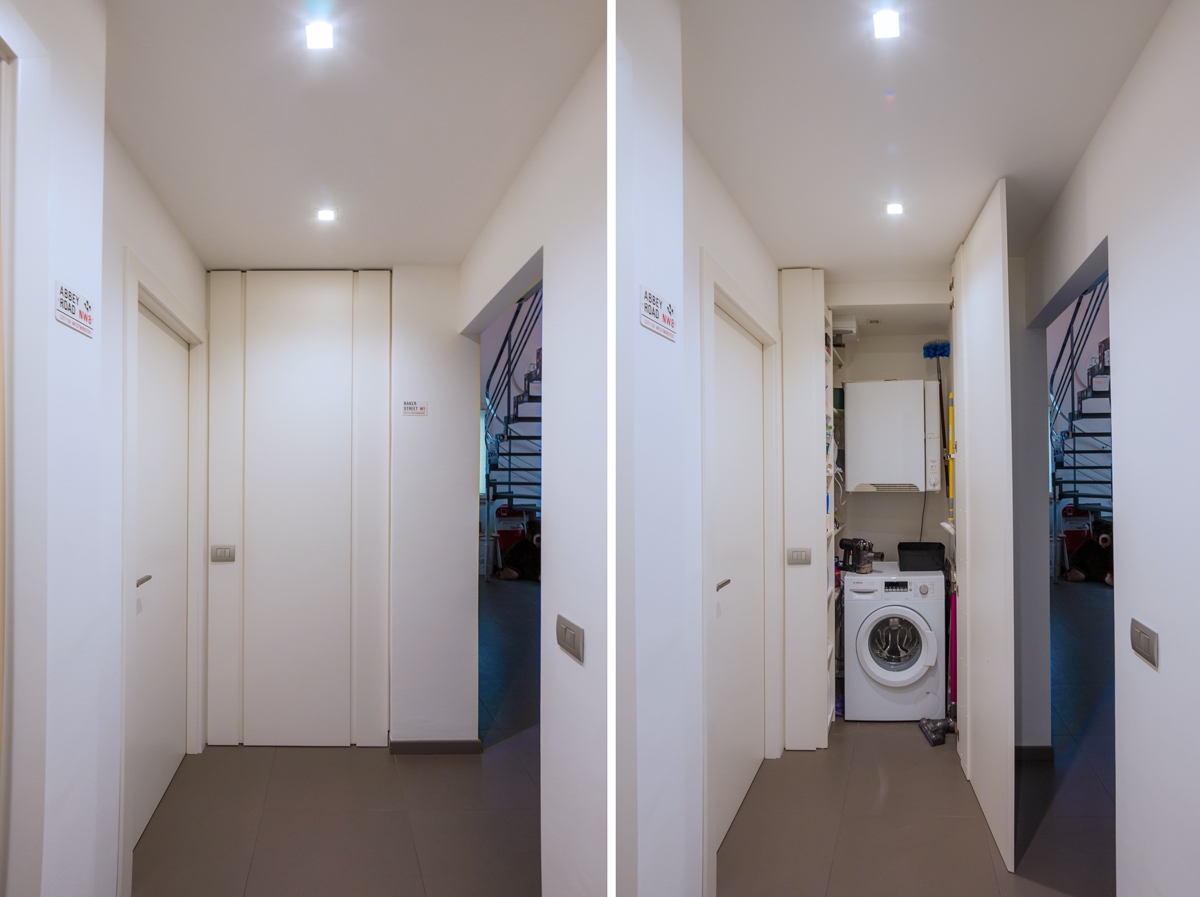
A laundry niche uses the available passage corner to house the washing machine and shelves View the project

From public washrooms to bathrooms equipped with laundry corners

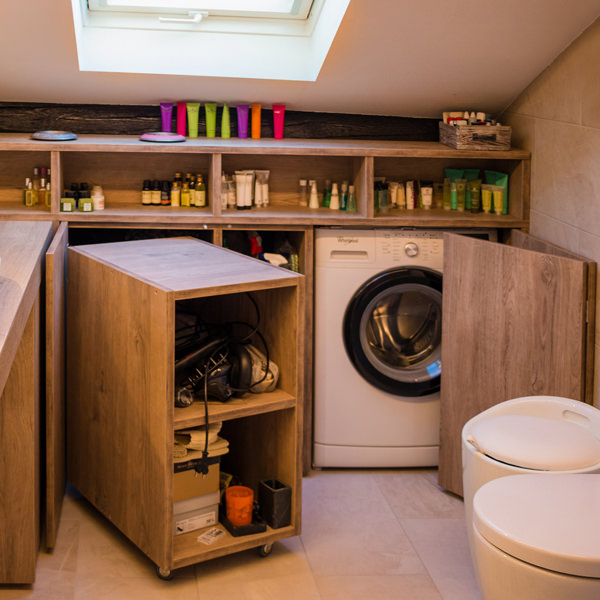
Over the years, the home laundry has become increasingly important in private houses. Whole rooms were equipped with basins and ironing corners, which gradually witnessed the coming of appliances capable of simplifying manual work and obtaining excellent results. Private rooms that replaced the traditional public lavatories for an increasingly elitist concept of personal care and cleaning. The widespread use of washing machines, and modern dryers, has meant that laundry rooms take up less and less space inside private houses. Furthermore, in the contemporary vision of the house, open spaces have swarmed the architectural panorama more and more, reducing the functional closings to the bare minimum. As a consequence, to optimize space, the laundry room is often eliminated in favor of bathrooms equipped with washing machines, dryers and service cupboards. Making the appliances “invisible” was the next step. Here then come equipped wardrobes able to hold not only washing machines and dryers but also baskets and pull-out compartments for cleaning products.

laundry bathroom detail

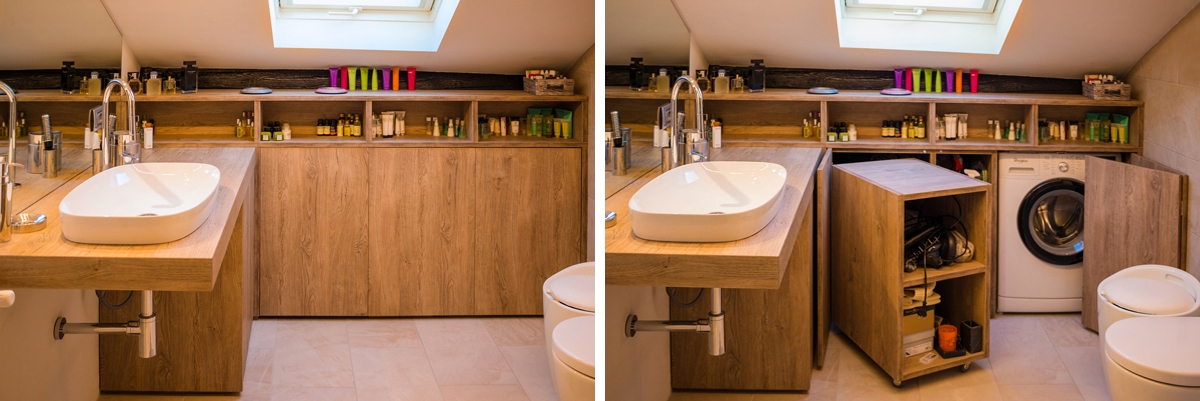
A bathroom with contemporary wooden surfaces hide extractable functional elements. View the project

Composition of a laundry-corner

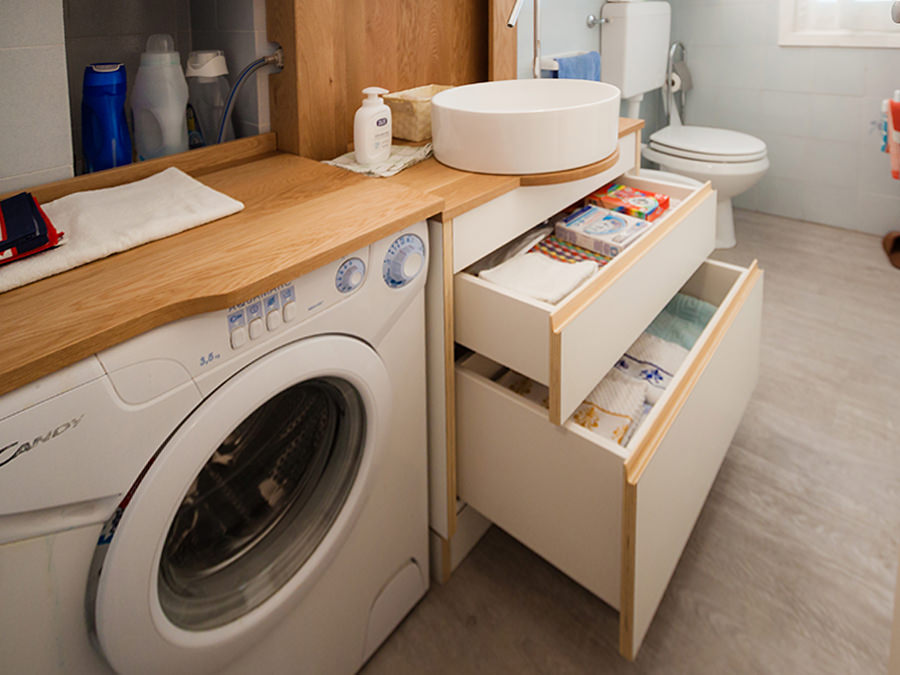
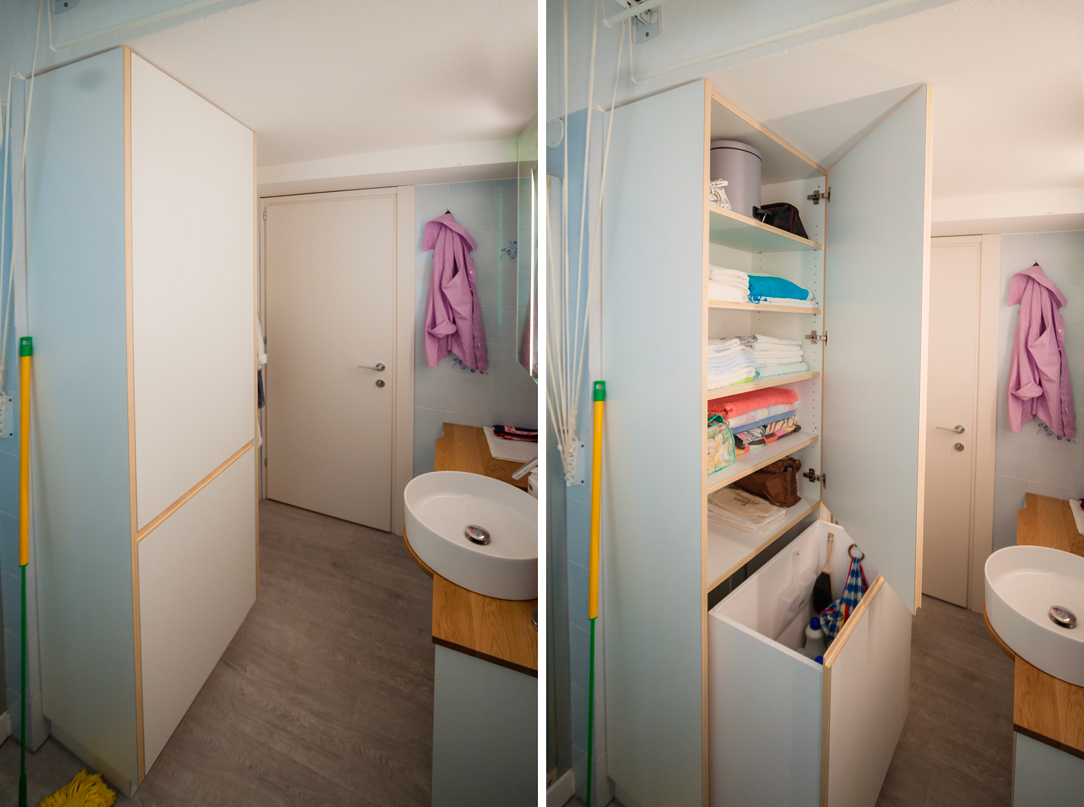
Equipping a bathroom with a laundry corner first of all means providing an insertion point for the washing machine. This can remain visible, favoring the opening of the porthole without interfering with any surrounding doors or being built-in the washbasin cabinet. To better hide the washing machine, however, it is necessary to provide a service cabinet that rests on the ground. It means excluding suspended solutions or light supports, and study a customed solution that allows the opening of the tray and the easily maintenance of the appliance. To this is often added a service cabinet with internal shelves and removable baskets that can contain cleaning products and accessories of different sizes. Often these latter two solutions come together in one, with folding or sliding doors, which act as a closure for the furniture element. Internal accessories such as dividers and hanging elements are additional options that can make the space more functional and optimize the overall dimensions.

bathroom with washing machine in view

The bathroom cabinet with wooden top and finishes houses the washing machine View the project

bathroom cabinet with open drawers

Drawers of different heights are extremely functional elements for organizing personal products View the project

bathroom service closet

A large service cupboard with internal shelves and removable basket for the bulky products View the project

It is the functionality that defines the composition of these equipped corners. Our task is to optimize spaces in the best possible way by creating practical and aesthetically satisfying solutions. Whether they are service points hidden in other rooms or clearly visible and recognizable elements, it is essential to be able to organize them in the best way, using all the available centimeters without however giving shape to narrow solutions.

SHAMPOO MILANO: A REVIVAL SHOP

SHAMPOO MILANO: A REVIVAL SHOP

A hairstylist salon in the heart of Navigli canals where the contemporaneity takes origin from the Fifties style and its retro taste.

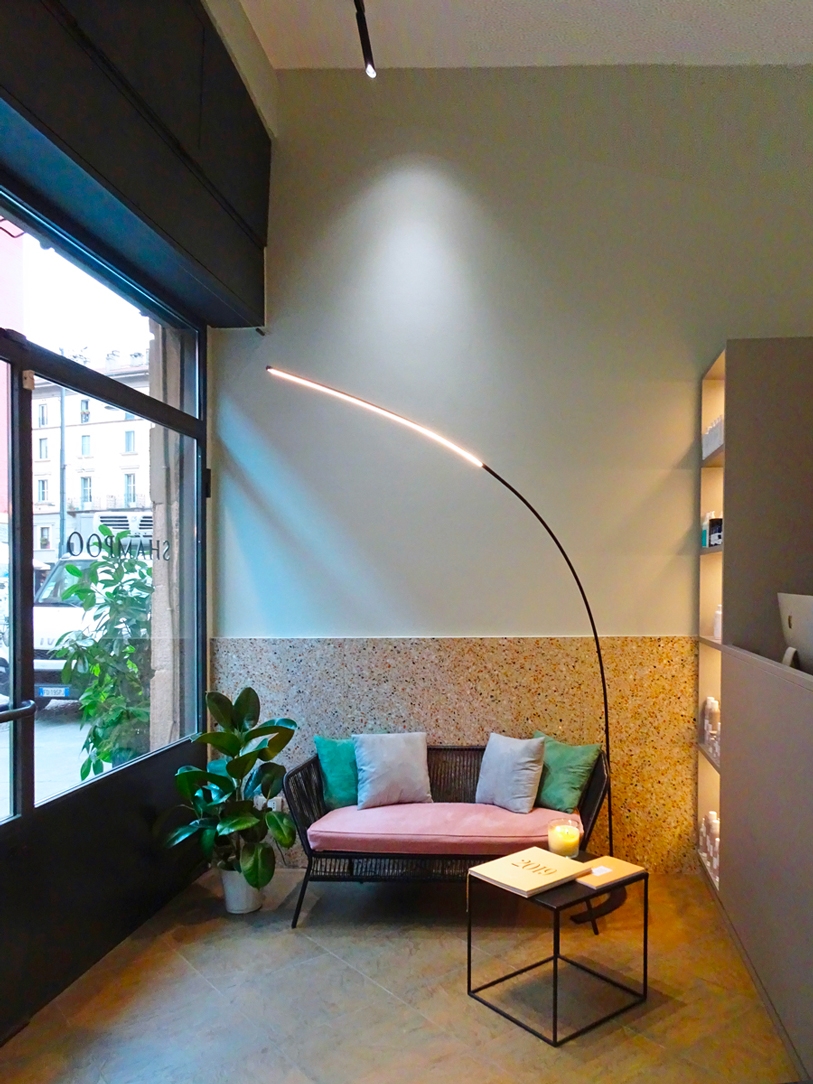
entrance hairstylist retail
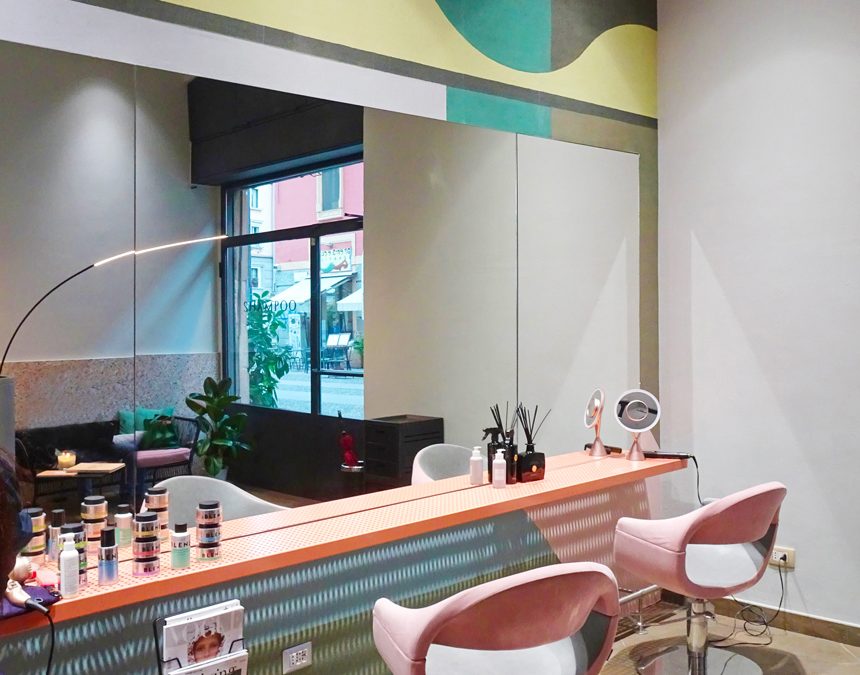
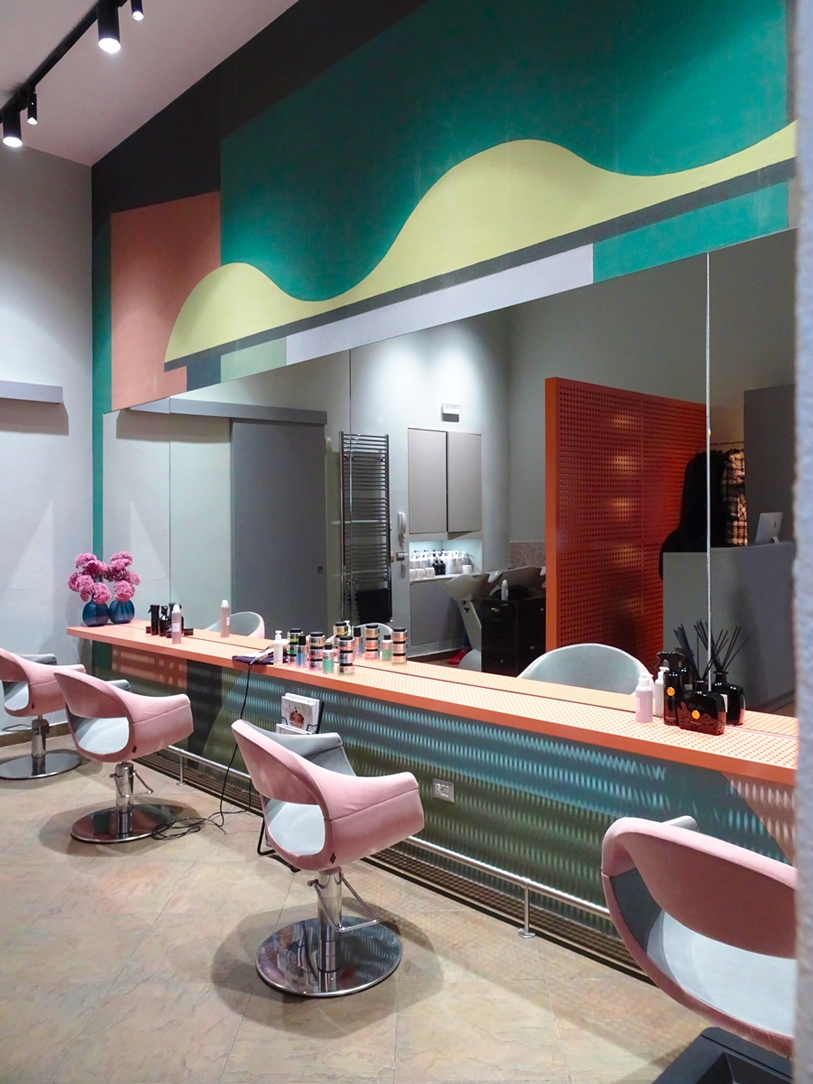
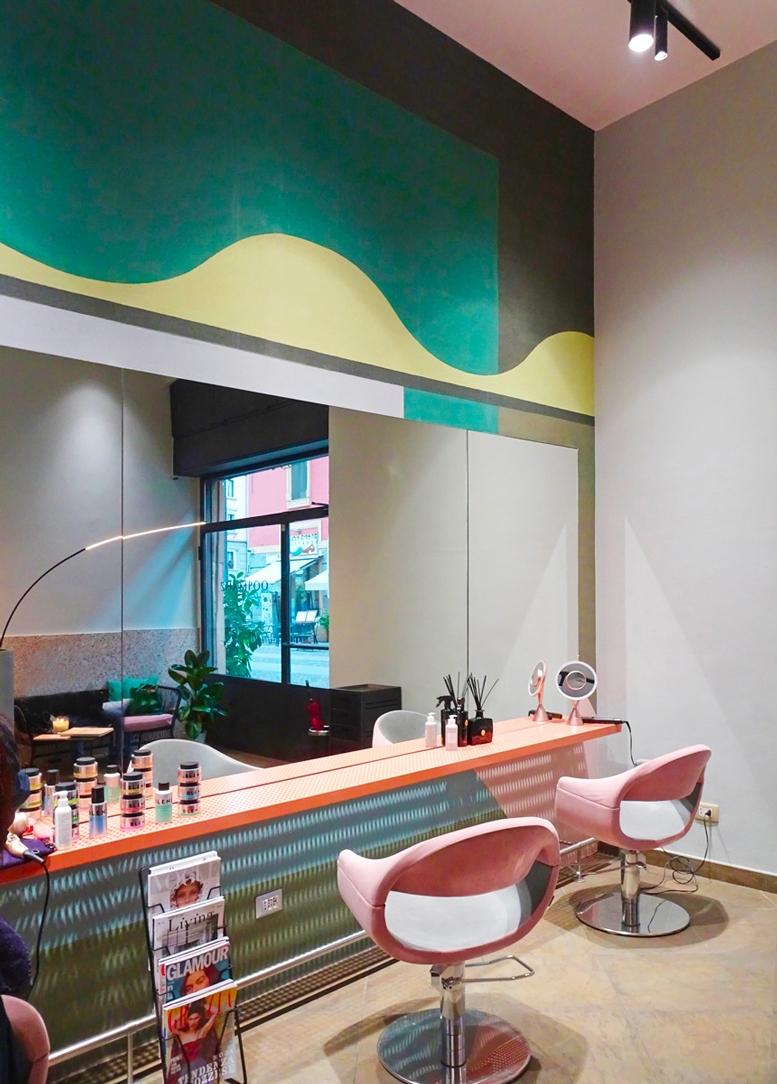
mirror hairstailist retail

THE CONTEXT

It’s commonly know that Milan is always gray, with this intervention we wanted to bring a color’s and freshness’s oasis! The Navigli canals are todays the heart of Milan’s nightlife, full of night clubs along the banks of canals, giving them lights and revival’s atmospheres. Up with the times and trends, they become undisputed ruler during the Milan Design Week and Fashion Week, holding events and installations that showcase the entire city. A contemporaneity that fits perfectly with the tradition of Milan. In fact, during the day, the small handcraft store comes to light with its traditionally setting that keep in time. Local craft shop and small atelier that looks to the contemporary tends with a careful production handed down during the time.

THE CONCEPT

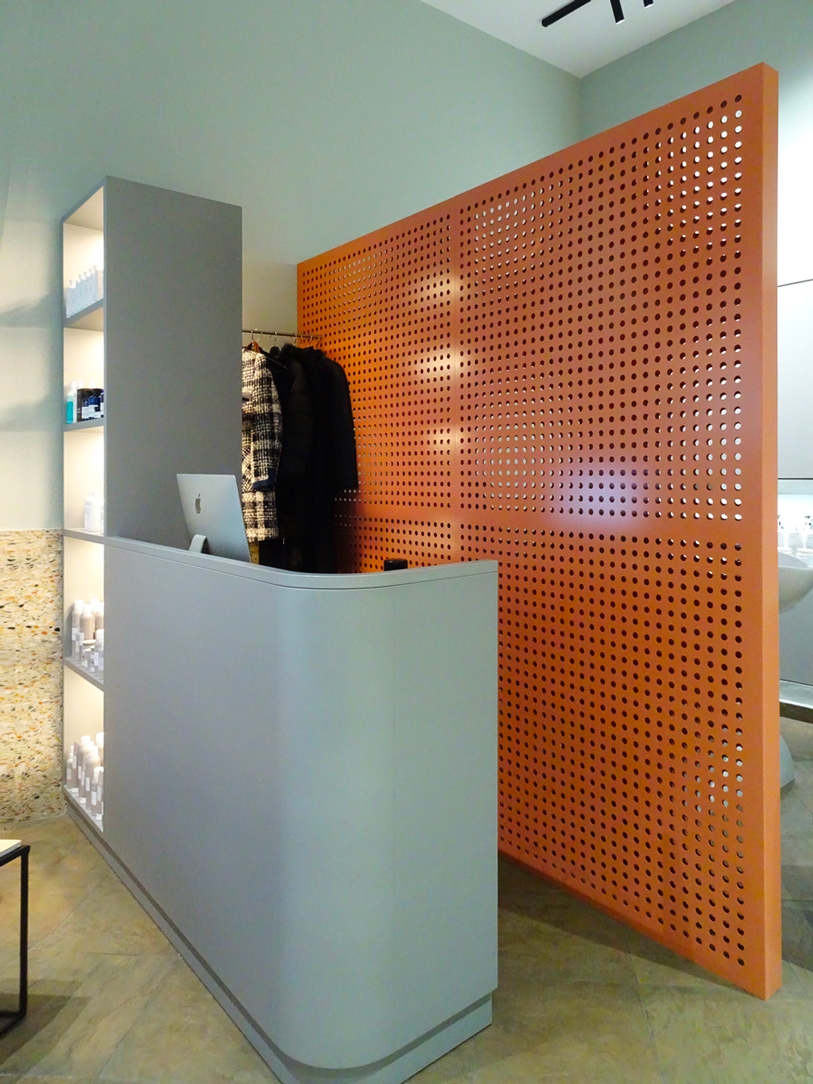
Know how to combine contemporaneity and historicity is also the key of this project, where the client’s request was exactly to make shape of a fresh and innovative location. A small space that clearly identify its internal room: starting from the clean and elegant entrance with its functional reception desk, passing to the essential but dynamic washing area, ending with the wide space for set and haircut and its large mirrors and spot lights.

 
entrance desk haistylist retail
mirror sheet

COLOURS, SHAPES AND MATERIALS.

The freshness of colours and the sinuosity of shapes refer themselves to the fifties interiors, reinterpreted in a contemporary view. The pastels shades are the starring role being able to strongly characterize the interiors, without giving up a touch of freshness and innovation. In this case, the salmon-coloured lacquering manages to take the perforated sheet off to the industrial context which it belongs and making it a characterize element of the environment. We find it again both in the back of the reception desk and in the support elements in correspondence with the mirrors. Added to this, the desk’s volume is designed to takes advance of its reduced spaces and at the same time bring out its functionally. The modern style gives a touch of elegance, without “grab the spotlight” to the perforated sheet.

THE ADVICE

Knowing how to identify each environment’s functionally it’s essential for a successful retail project. Sometimes a touch of colour it’s enough for bring to client’s attention and holding all the stylistic characteristic of the store.

Organize rooms with a secret library

Organize rooms with a secret library

Organize the room can be a difficult task, especially if this room is small and not very functional, but often the solution is just around the corner: in this case, around a corner library which hosts a secret door. THE PROBLEM ANALYSIS THE PROJECT PROPOSAL COLOURS, SHAPES AND MATERIALS THE ADVICE  

THE PROBLEM ANALYSIS

Living in big cities often means to interacts with the lack of space and environments with small dimensions. In those contexts, the functionality it’s an indispensable design element: It allows us to take the most advantage from each room without sacrificing comfort and aesthetic values, while at the same time it solves important problems. The functionality is not just the added value to our interiors, but first at all a stylistic key. A proof of that is this Milan’s apartment. The entrance overlooks a comfortable and contemporary living room characterized by light colours of walls and furniture which create a contrast with an elegant wooden dark floor with which it harmoniously communicates. The design challenge provide for two mainly solutions: on one hand the lack of a real library, which can easily become a characterized element of the room showing at the same time small design object and souvenir able to describe the personality of its inhabitants. On the other hand, the need of hide the bath entrance which is more intimate and private, whose door faces directly in the living room, in a contact view with the entrance hall.  

THE PROJECT PROPOSAL

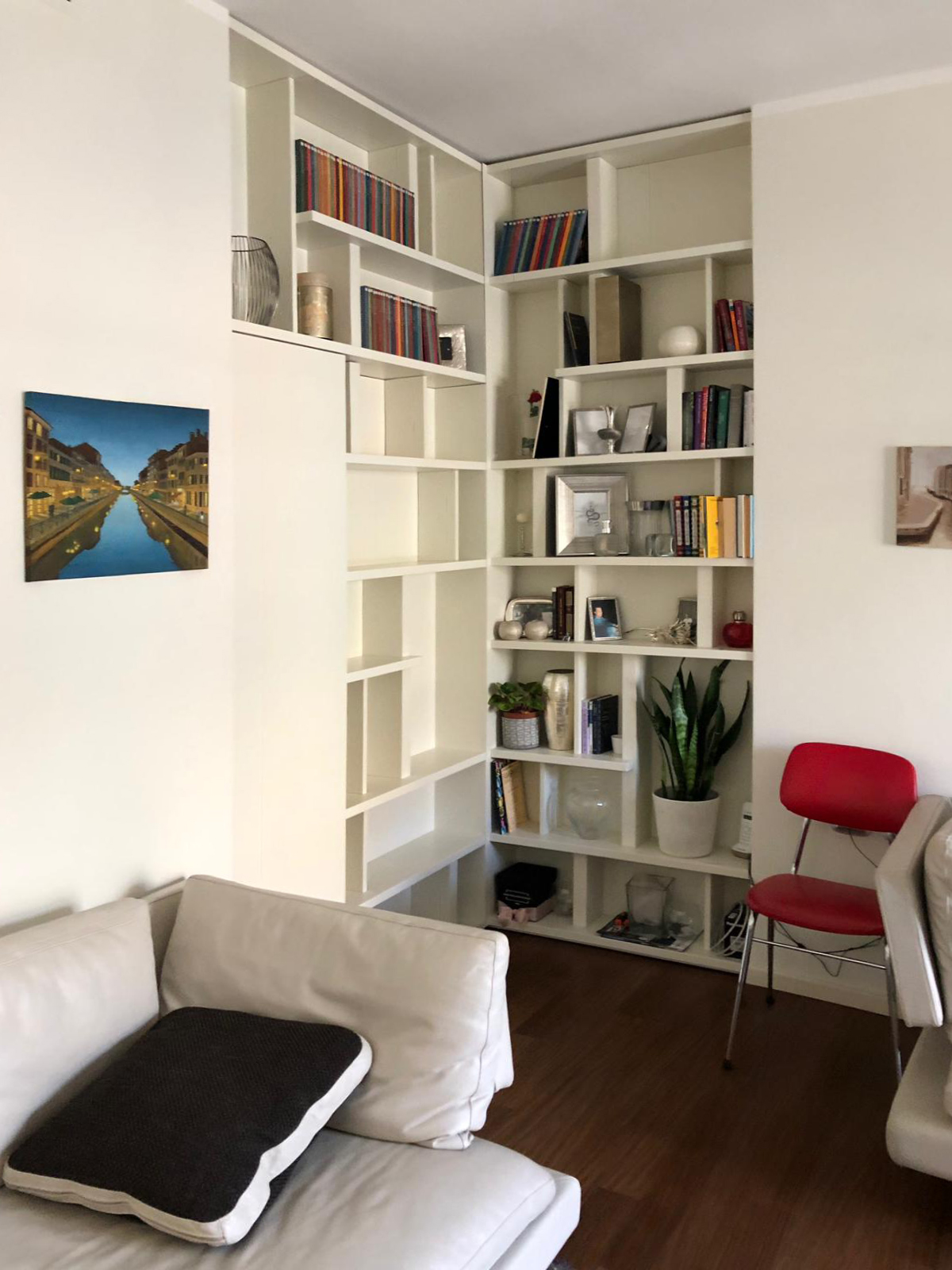
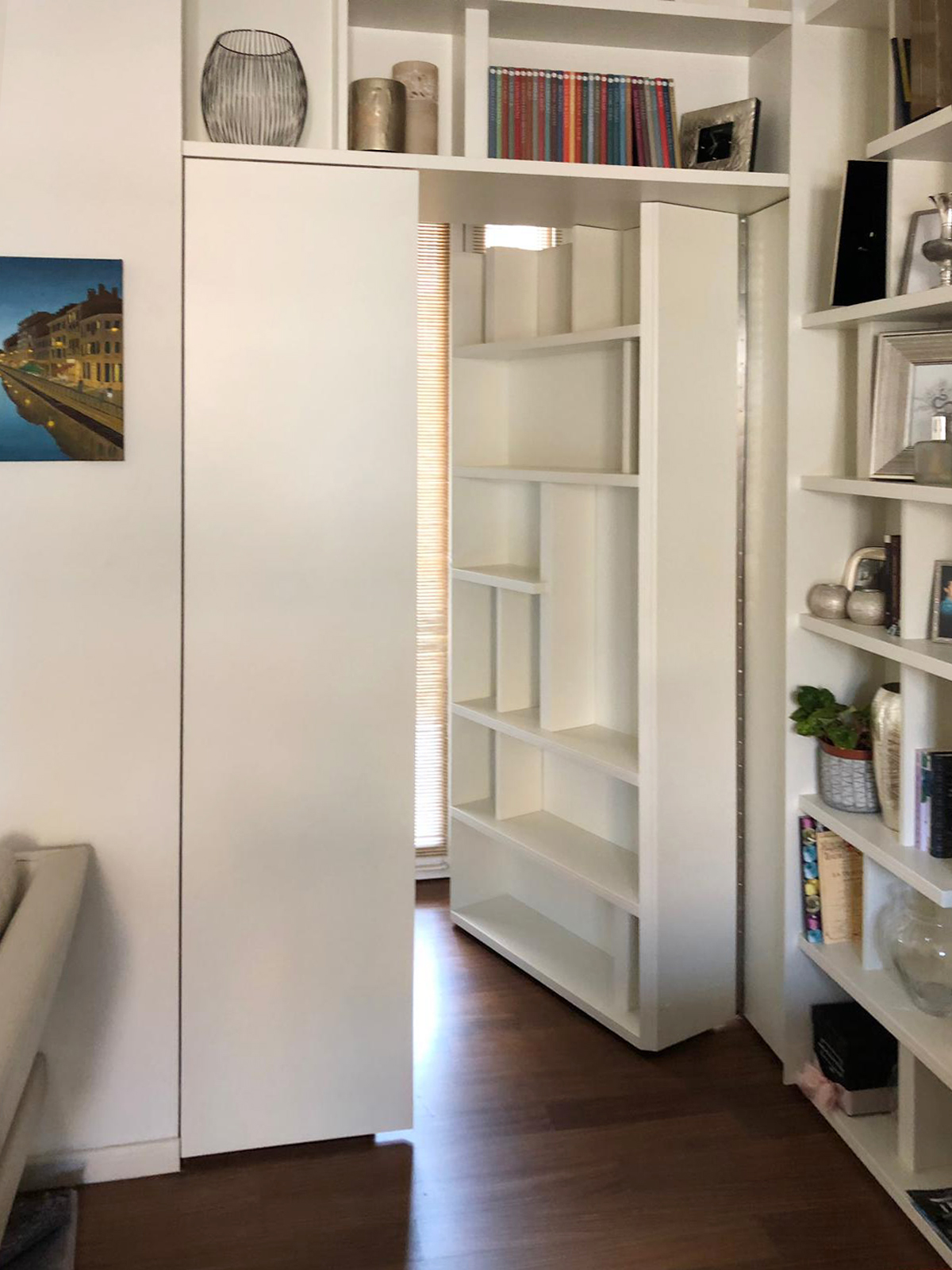
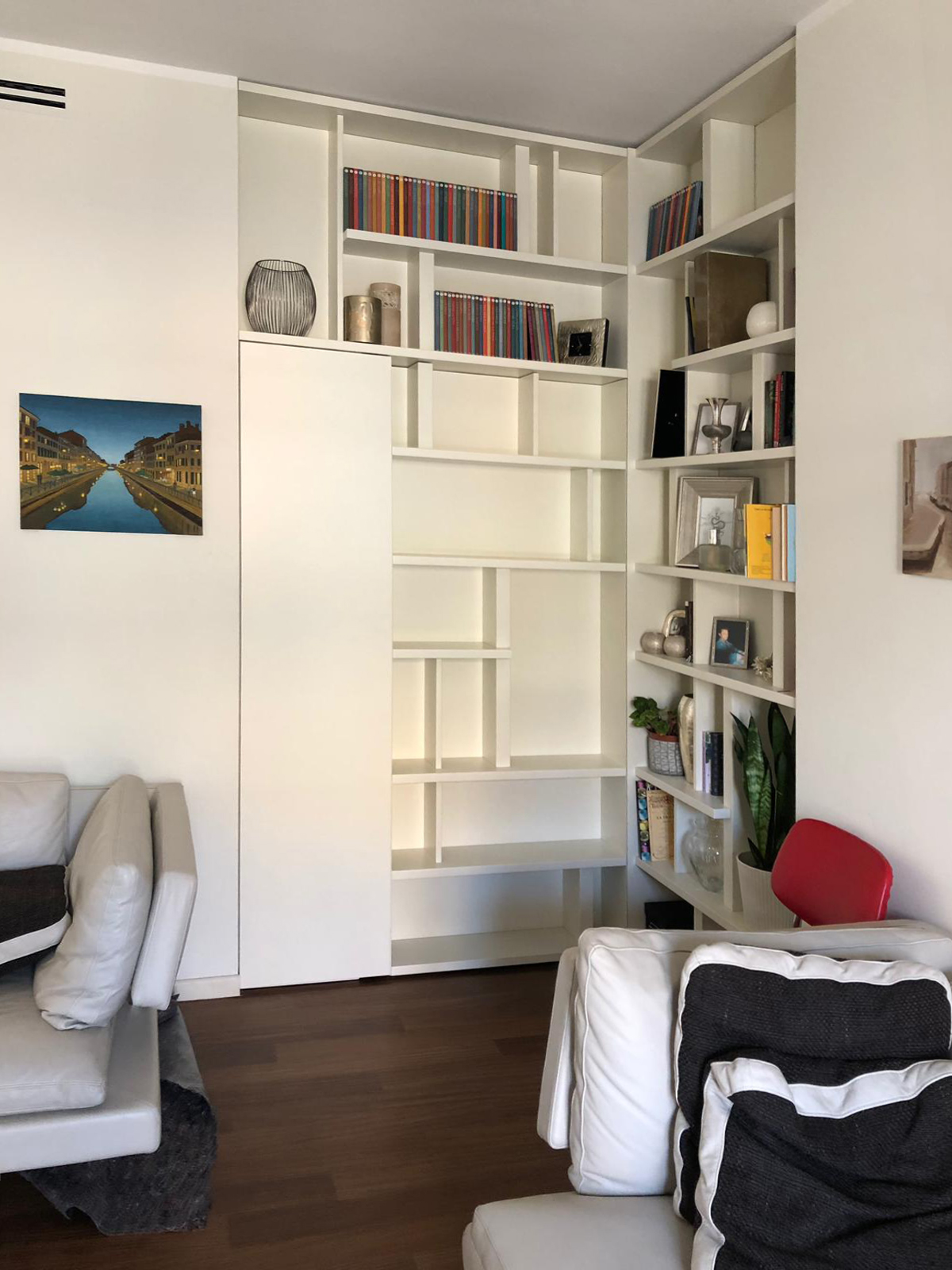
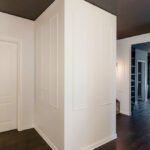
The design solution manages to solve both problems in a single functional element: a wall unit able to provide display support for books and small objects and, at the same time, combines the real bathroom’s door. A dynamic bookcase that reflects the intentionally asymmetric layout in both corner elements. Taking advantage from the corner position, in fact, the two different components of the bookcase are organized as autonomous elements whose shelves could easily become the stylistic line enable to give rhythm and harmony.  This, defines the internal recess of the library which allows the management of exposed elements as a costumed setting, a sort of display windows of the inhabitants’ personalities. The entrance to the bathroom takes place with complete discretion, as a sort of a real “secret passage”, activated by pressing. In particular, the door consists of a fixed narrower shutter, even equipped in the bathroom’s ambient, and a main shutter that in its external side has a considerably bigger thickness than the traditional in order to accommodate books and small objects.  

COLOURS, SHAPES AND MATERIALS

The contemporary imprint is visible both in the graphic layout of the library, which combines full and empty space in perfectly harmony as in a typographic composition, but above all for the material and chromatic choice. In particular, a white opaque lacquered MDF was chosen to create the partition wall. This because it allows a better versatility clearly visible for example, in the different thickness with which were made the numerous internal shelves. The 9010 white recalls the dining’s wall and the contemporary furniture, inserting itself without intrusiveness in the room but at the same time managing to define the stylistic print.  

THE ADVICE

No problems had to remains unsolved! Sometimes a furniture element becomes the custom-made solution able to solve in the best way different problems, as it can be the lack of space or the need to divide rooms.

The wall units perfectly combine elegancy and functionality and can also contain hidden mechanism to take the most advantage from its practicality. A mechanism that can also be fun! Divide the rooms has never been so easy, a library with a secret door it’s enough.

 
corner secret library
open door corner library
closed door corner library